Die Wiederentdeckung des weißen Lichts
Breites Spektrum vs. enges Spektrum
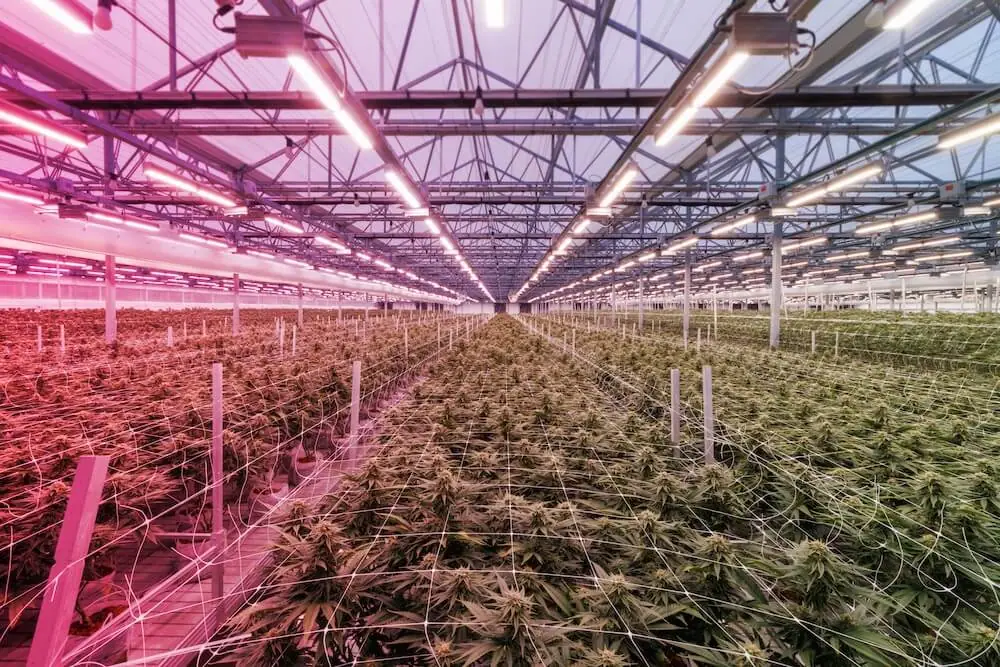
Die Beleuchtungstechnologien im Gartenbau haben sich im letzten Jahrhundert dramatisch verbessert, aber die Manipulation des Lichtspektrums ist ein recht neues Konzept. Da Pflanzen in der Regel rotes und blaues Licht am stärksten absorbieren, wurden andere Wellenlängen als unnötig für das Pflanzenwachstum und die Entwicklung angesehen. Mit dem Fortschritt der LED-Technologie wurde auch die Möglichkeit, individuelle Spektren zu erzeugen, verbessert, und rosa/violette Leuchten überschwemmten den Beleuchtungsmarkt im Gartenbau. Ungeachtet dieses Zustroms von Produkten untersuchte die Forschung im Bereich der Pflanzenbeleuchtung weiterhin die zahlreichen Wechselwirkungen zwischen Pflanzen und Licht und begann schließlich, die Vorstellung zu widerlegen, dass Pflanzen für ein optimales Wachstum nur zwei individuelle Spektren benötigen. Zwar gibt es immer noch viele Unstimmigkeiten über die primäre Funktion von Licht im Bereich von 550 nm bis 600 nm sowie im fernroten und ultravioletten Wellenbereich, aber die Forschung hat viele Funktionen und sogar Vorteile der Einbeziehung dieser Spektren gezeigt. Um zu verstehen, wie Pflanzen Licht wahrnehmen, wird in diesem Artikel auf die vielen bekannten Rezeptoren und Pigmente eingegangen, mit denen Pflanzen ihre Umwelt wahrnehmen und auf sie reagieren.
Wie Pflanzen Licht nutzen
Human and plant light perception use many of the same molecules, however, our eyes are more easily fooled. Narrow band red, blue, and green light when mixed in the right proportion are perceived as white light to the human eye. However, a plant is quite aware of the fact that it is receiving three individual spectra and its growth habit will demonstrate that perception. Broad spectrum white light can come in many forms depending on the source. To the human eye, we mostly perceive these different spectra as cooler (blue) or warmer (orange/red) depending if it is a metal halide or high-pressure sodium lamp, or in the case of LEDs and fluorescent bulbs, what type of phosphor coating is used. To a plant however, each individual wavelength may promote a different growth habit and photomorphogenic response.
Incoming photons are absorbed by pigments, which absorb light as energy, and photoreceptors which perceive light as a signal. When absorbed by the most known pigment, chlorophyll, photons can be used to drive photosynthesis and growth. However, chlorophyll alone with its wide-ranging absorption spectrum is not enough to efficiently harvest light. The “antenna complex” is a concept that describes how accessory pigments such as carotenoids can assist both in capturing light that chlorophyll does not absorb, or dissipating excess light as heat (non-photochemical quenching) when photosynthetic reaction centers are overloaded with incoming energy.
Accessory pigments are primarily carotenoids such as beta-carotene, lutein, zeaxanthin, antheraxanthin, and violaxanthin. These pigments are yellow to orange in color and absorb most strongly in the range of 450 nm to 550 nm. Some of these pigments change forms based on lighting conditions through processes called epoxidation and de-epoxidation. If fluence is too high, damage can occur to the photosynthetic apparatus, so it is important for a plant to be able to deal with this incoming energy. Under pure sunlight where fluence may fluctuate throughout the day, the antenna complex adjusts to accept or dissipate light. When fluence is low, violaxanthin will capture photons and transfer this energy to chlorophyll, improving efficiency of light absorption. When fluence is high, violaxanthin is de-epoxidated (converted) into zeaxanthin which then dissipates excess photons as heat. Beta-carotene functions similarly to violaxanthin and lutein functions like zeaxanthin but without this interconversion process called the “Xanthophyll Cycle.” This flow of energy between pigments occurs spontaneously as they become “excited” by photons. Interestingly, carotenoids that protect plants from light and improve their ability to capture light can also serve similar functions within the eyes of many animal species. There are several other plant pigments unassociated with the photosynthetic light-harvesting complex including anthocyanin and lycopene. Though these compounds do absorb light, their main function is to protect cells and DNA from damaging UV radiation as well as scavenge “free radicals” such as hydrogen peroxide, preventing further cellular damage.
Photoreceptors in most cases are proteins paired with a “chromophore” that absorbs certain wavelengths of light and then sends a signal to the plant that influences photomorphogenesis. There are several different types of photoreceptors and their light absorption ranges overlap. Cryptochromes use light in the range of 300 nm to 500 nm though it most strongly absorbs at 350 nm (UV-A) and 450 nm (blue). This receptor, when excited by light, prevents elongation of hypocotyls (main stem of seedlings) and even mediates flowering and photoperiod in some species. Phototropins are also blue/UV-A absorbing photoreceptors but with a much stronger absorption peak at 450 nm and are thought to regulate phototropism (process in which plants move in response to light), stomatal aperture (opening and closing), movement of chloroplasts (photosynthetic organelles) within leaf cells, and inhibition of leaf expansion. Phytochromes are some of the more famous photoreceptors as they can strongly influence flowering. It is a little known fact that phytochromes actually absorb light in the range of 300 nm to 800 nm. Most of the known functions however, are a result of the absorption peaks at 660 nm in the Pr form and 730 nm in the Pfr form. Phytochromes are constantly changing form and reach a “photoequilibrium” (more information available in the “Guide to Photomorphogenesis”) that is regulated by spectral ratio and PPFD present in the growing environment. Depending on the photoequilibrium of phytochrome, different signals are sent to metabolic pathways within the plant that regulate many processes including germination, seedling establishment, stem elongation, leaf expansion, and of course flowering and photoperiod. Different ratios of R:FR light received by a plant will dictate how the plant develops in terms of compactness, flower size, flower number, etc. There are several other newly discovered and under-researched photoreceptors (UV-B receptor correlated with anthocyanin accumulation) but these will not be discussed in this article.
Since there is much overlap in the absorption spectra of these photoreceptors, most photomorphogenic responses are co-regulated. Some responses may be turned on and off by one receptor, but the expression of that response can be amplified by another receptor. The enigmatic “circadian clock” that regulates so many functions within plants is a culmination of activity from multiple photoreceptors entraining a rhythm of growth patterns based on photoperiod, light spectrum, and PPFD. This rhythm of growth patterns within a plant strongly influences photomorphogenic outcomes however, just like photosynthesis, there is an action spectrum for all photomorphogenic responses that is dictated by a mixture of signals from these photoreceptors and does not necessarily mirror the absorption spectrum.
Ergänzung spezifischer Wellenlängen im Vergleich zum Breitbandspektrum
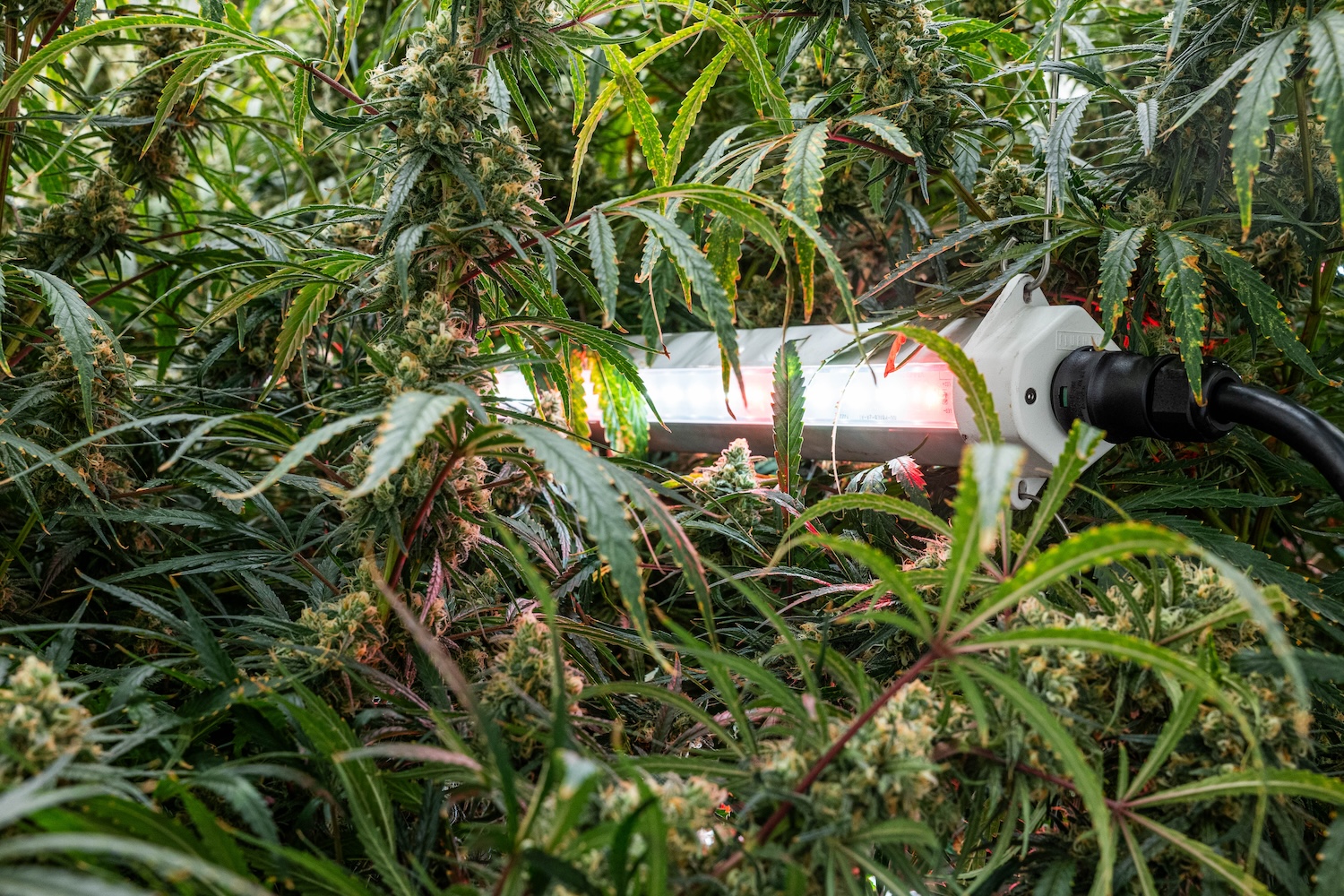
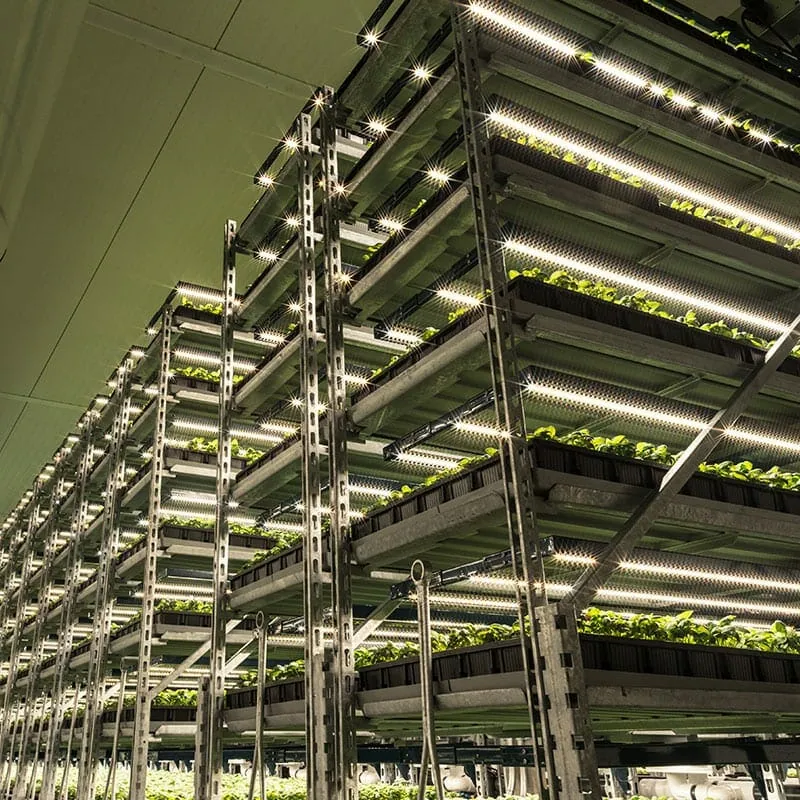
Wenn Sie den Einsatz von Schmalbandbeleuchtung in Erwägung ziehen, müssen Sie vor allem berücksichtigen, ob Ihre Pflanzen bereits mit Breitbandspektrumlicht (Solarlicht für Gewächshäuser oder eine Breitbandspektrumleuchte für Anwendungen mit alleiniger Beleuchtung) bestrahlt werden und welche Pflanzen Sie anbauen. Wenn die Pflanzen bereits mit Breitbandspektrum-Licht aus einer einzigen Beleuchtungsquelle beleuchtet werden, ist eine Ergänzung mit Schmalband-Licht nur dann sinnvoll, wenn ein gewünschter photomorphogener Effekt erzielt werden soll, den die Pflanzen ohne den Kontakt mit einem bestimmten Wellenbereich nicht erreichen können. Wenn Sie jedoch unter Sonneneinstrahlung und einem hohen DLI anbauen, kann es sein, dass Ihre Pflanzen nicht so empfindlich auf Veränderungen des Lichtspektrums reagieren, da die Sonneneinstrahlung bereits recht breit ist und die photomorphogenen Vorteile der Schmalbandbeleuchtung übertönen kann. Ein weiterer Aspekt, der beim Anbau unter Sonneneinstrahlung zu berücksichtigen ist, ist die Frage, ob Sie Ihren DLI erhöhen müssen oder nicht. Wenn Sie den DLI mit einer Schmalbandleuchte erhöhen, kann es zu Unregelmäßigkeiten in der Produktqualität kommen, da die Sonneneinstrahlung im Laufe des Jahres zu- und abnimmt und Ihre Pflanzen unterschiedlichen Mengen an Sonnenlicht und Schmalbandlicht ausgesetzt sind. Wenn Ihr DLI konstant ist und Sie nur eine photomorphogene Reaktion wie Färbung, Kompaktheit oder Bewurzelung hervorrufen wollen, kann es sinnvoll sein, mehr blaues Licht zu verwenden. Allerdings hat der DLI oft einen größeren Einfluss auf die gewünschten Eigenschaften als das Spektrum. Wenn Sie eine blühende/fruchttragende Pflanze anbauen und nur das Wachstum von Blüten/Früchten fördern möchten (mit einem ausreichenden DLI und einer ausreichenden Photoperiode), kann es von Vorteil sein, mehr rotes Licht zu verwenden, da Licht mit 660 nm bei vielen Arten Phytochrom-Reaktionen auslöst, die Signale an die gesamte Pflanze senden, um das reproduktive Wachstum zu fördern.
Schlussfolgerung
Schmalbandige Beleuchtung kann bei vielen Arten ein akzeptables Wachstum ermöglichen. Pflanzen verwenden jedoch mehrere verschiedene Photorezeptoren und Pigmente, die Wachstum und Entwicklung gemeinsam regulieren. Pflanzen haben diese photomorphogenen Reaktionen unter Breitspektrumlicht entwickelt, und es ist sehr selten, dass eine bestimmte Art eine Reaktion auf Schmalbandlicht zeigt, die bei ausreichendem DLI nicht auch durch Breitspektrumlicht erreicht werden kann. Für eine gleichbleibende Produktqualität und die Möglichkeit, eine breite Palette von Pflanzenarten ohne beleuchtungsbedingte Komplikationen zu produzieren, sind Breitspektrumleuchten die sicherere Wahl. Verschiedene Arten können unterschiedlich auf Veränderungen im Lichtspektrum reagieren. Es werden ständig Forschungsarbeiten durchgeführt, die uns helfen zu verstehen, wie einzelne Pflanzen auf verschiedene Lichtspektren reagieren, und in einigen Fällen gibt es eindeutige Hinweise darauf, welche Art von Beleuchtung für eine Pflanze am besten ist. Wenn Sie sich nicht sicher sind, wie Ihre Pflanzen darauf reagieren, hat sich die Ergänzung mit Breitspektrum-Licht bewährt, um die Qualität, die Konsistenz und den Ertrag der Pflanzen zu verbessern.