Redescubrir la luz blanca
Espectro amplio frente a espectro estrecho
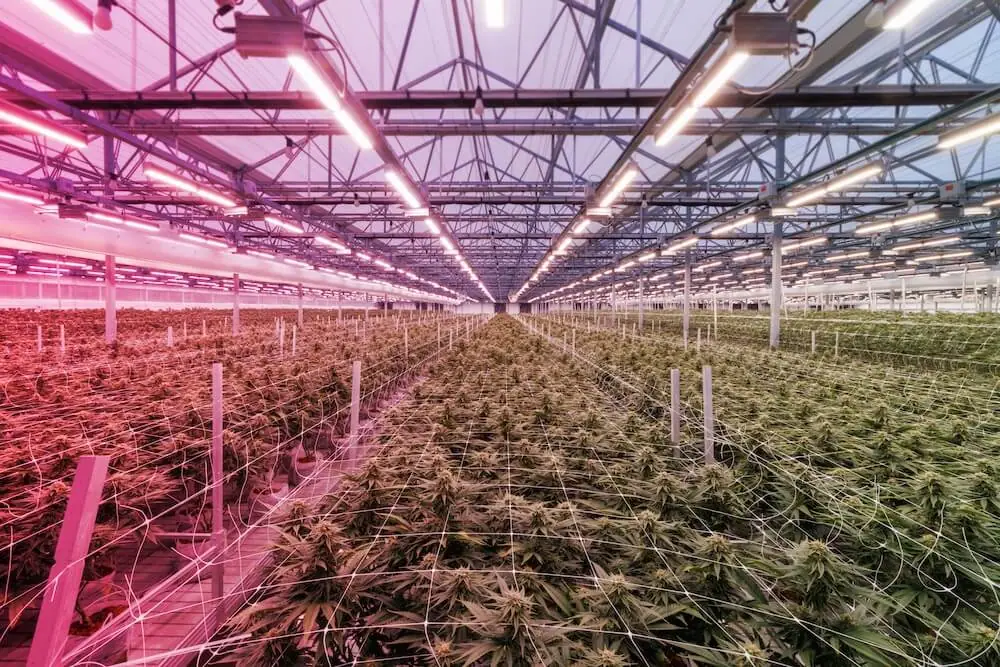
Las tecnologías de iluminación hortícola han mejorado mucho en el último siglo, pero la manipulación del espectro luminoso es un concepto bastante nuevo. Dado que las plantas tienden a absorber más la luz roja y azul, las demás longitudes de onda se han considerado innecesarias para su crecimiento y desarrollo. A medida que avanzó la tecnología LED, también lo hizo la capacidad de proporcionar espectros individuales, y los aparatos de luz rosa/morada inundaron el mercado de la iluminación hortícola. Independientemente de esta afluencia de productos, la investigación sobre la iluminación de las plantas siguió explorando las numerosas interacciones que éstas tienen con la luz y, finalmente, empezó a desaconsejar la idea de que las plantas sólo necesitaban dos espectros individuales para un crecimiento óptimo. Aunque sigue habiendo mucha discrepancia sobre la función principal de la luz en el rango de 550 nm a 600 nm, así como en las bandas de onda del rojo lejano y el ultravioleta, la investigación ha demostrado muchas funciones e incluso beneficios de la incorporación de estos espectros. Para ayudarle a comprender cómo perciben la luz las plantas, este artículo profundiza en los numerosos receptores y pigmentos conocidos que las plantas utilizan para percibir y responder a su entorno.
Cómo utilizan la luz las plantas
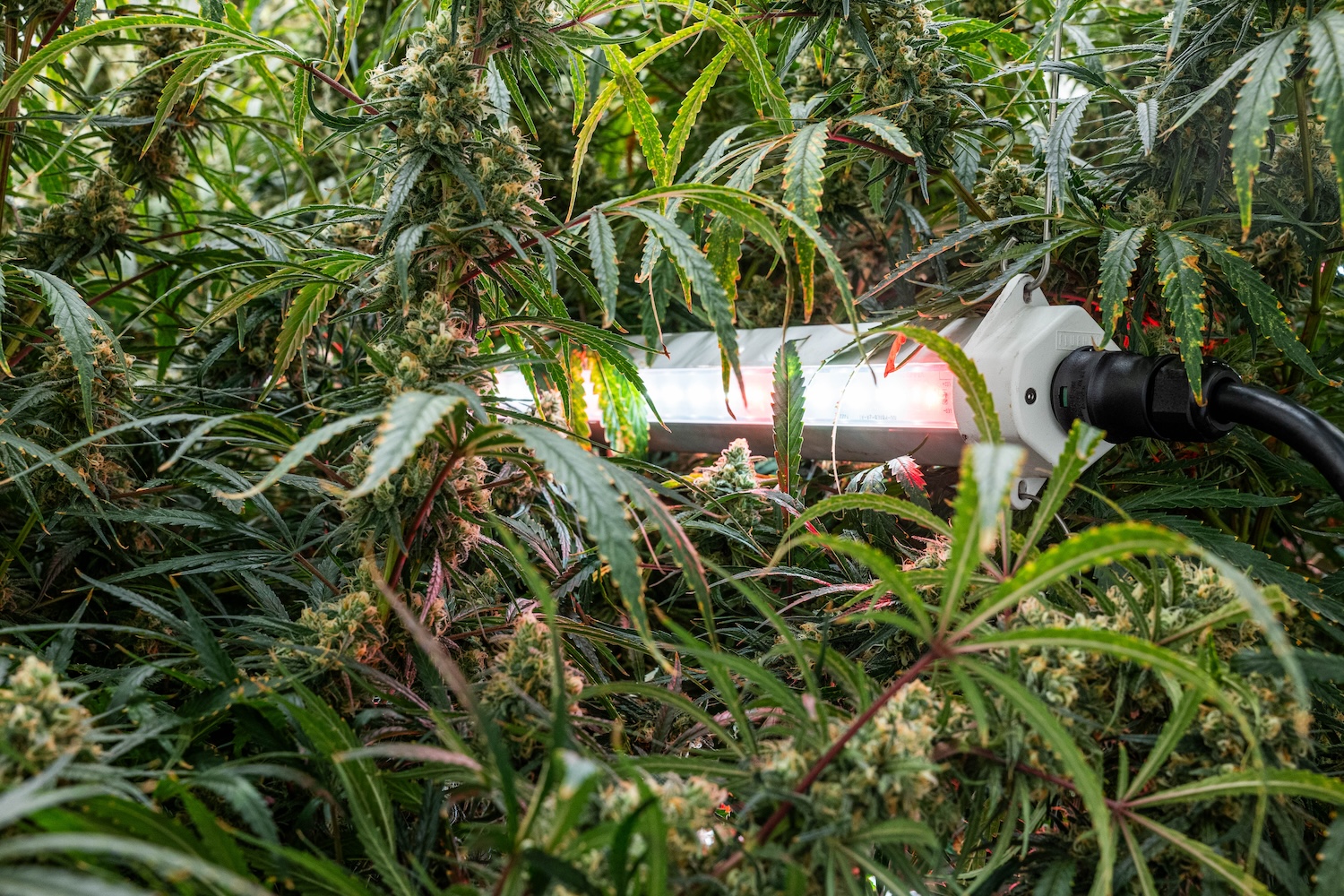
Human and plant light perception use many of the same molecules, however, our eyes are more easily fooled. Narrow band red, blue, and green light when mixed in the right proportion are perceived as white light to the human eye. However, a plant is quite aware of the fact that it is receiving three individual spectra and its growth habit will demonstrate that perception. Broad spectrum white light can come in many forms depending on the source. To the human eye, we mostly perceive these different spectra as cooler (blue) or warmer (orange/red) depending if it is a metal halide or high-pressure sodium lamp, or in the case of LEDs and fluorescent bulbs, what type of phosphor coating is used. To a plant however, each individual wavelength may promote a different growth habit and photomorphogenic response.
Incoming photons are absorbed by pigments, which absorb light as energy, and photoreceptors which perceive light as a signal. When absorbed by the most known pigment, chlorophyll, photons can be used to drive photosynthesis and growth. However, chlorophyll alone with its wide-ranging absorption spectrum is not enough to efficiently harvest light. The “antenna complex” is a concept that describes how accessory pigments such as carotenoids can assist both in capturing light that chlorophyll does not absorb, or dissipating excess light as heat (non-photochemical quenching) when photosynthetic reaction centers are overloaded with incoming energy.
Accessory pigments are primarily carotenoids such as beta-carotene, lutein, zeaxanthin, antheraxanthin, and violaxanthin. These pigments are yellow to orange in color and absorb most strongly in the range of 450 nm to 550 nm. Some of these pigments change forms based on lighting conditions through processes called epoxidation and de-epoxidation. If fluence is too high, damage can occur to the photosynthetic apparatus, so it is important for a plant to be able to deal with this incoming energy. Under pure sunlight where fluence may fluctuate throughout the day, the antenna complex adjusts to accept or dissipate light. When fluence is low, violaxanthin will capture photons and transfer this energy to chlorophyll, improving efficiency of light absorption. When fluence is high, violaxanthin is de-epoxidated (converted) into zeaxanthin which then dissipates excess photons as heat. Beta-carotene functions similarly to violaxanthin and lutein functions like zeaxanthin but without this interconversion process called the “Xanthophyll Cycle.” This flow of energy between pigments occurs spontaneously as they become “excited” by photons. Interestingly, carotenoids that protect plants from light and improve their ability to capture light can also serve similar functions within the eyes of many animal species. There are several other plant pigments unassociated with the photosynthetic light-harvesting complex including anthocyanin and lycopene. Though these compounds do absorb light, their main function is to protect cells and DNA from damaging UV radiation as well as scavenge “free radicals” such as hydrogen peroxide, preventing further cellular damage.
Photoreceptors in most cases are proteins paired with a “chromophore” that absorbs certain wavelengths of light and then sends a signal to the plant that influences photomorphogenesis. There are several different types of photoreceptors and their light absorption ranges overlap. Cryptochromes use light in the range of 300 nm to 500 nm though it most strongly absorbs at 350 nm (UV-A) and 450 nm (blue). This receptor, when excited by light, prevents elongation of hypocotyls (main stem of seedlings) and even mediates flowering and photoperiod in some species. Phototropins are also blue/UV-A absorbing photoreceptors but with a much stronger absorption peak at 450 nm and are thought to regulate phototropism (process in which plants move in response to light), stomatal aperture (opening and closing), movement of chloroplasts (photosynthetic organelles) within leaf cells, and inhibition of leaf expansion. Phytochromes are some of the more famous photoreceptors as they can strongly influence flowering. It is a little known fact that phytochromes actually absorb light in the range of 300 nm to 800 nm. Most of the known functions however, are a result of the absorption peaks at 660 nm in the Pr form and 730 nm in the Pfr form. Phytochromes are constantly changing form and reach a “photoequilibrium” (more information available in the “Guide to Photomorphogenesis”) that is regulated by spectral ratio and PPFD present in the growing environment. Depending on the photoequilibrium of phytochrome, different signals are sent to metabolic pathways within the plant that regulate many processes including germination, seedling establishment, stem elongation, leaf expansion, and of course flowering and photoperiod. Different ratios of R:FR light received by a plant will dictate how the plant develops in terms of compactness, flower size, flower number, etc. There are several other newly discovered and under-researched photoreceptors (UV-B receptor correlated with anthocyanin accumulation) but these will not be discussed in this article.
Since there is much overlap in the absorption spectra of these photoreceptors, most photomorphogenic responses are co-regulated. Some responses may be turned on and off by one receptor, but the expression of that response can be amplified by another receptor. The enigmatic “circadian clock” that regulates so many functions within plants is a culmination of activity from multiple photoreceptors entraining a rhythm of growth patterns based on photoperiod, light spectrum, and PPFD. This rhythm of growth patterns within a plant strongly influences photomorphogenic outcomes however, just like photosynthesis, there is an action spectrum for all photomorphogenic responses that is dictated by a mixture of signals from these photoreceptors and does not necessarily mirror the absorption spectrum.
Suplemento de longitudes de onda específicas frente a amplio espectro
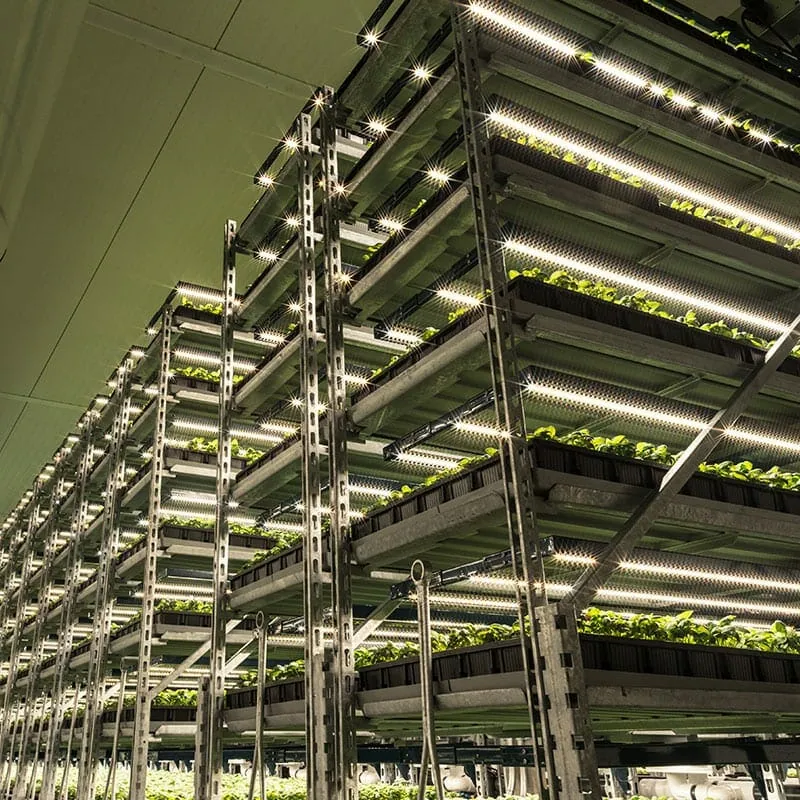
A la hora de considerar el uso de iluminación de banda estrecha, los aspectos más importantes que hay que tener en cuenta son si las plantas ya están expuestas a luz de amplio espectro (solar para invernaderos, o una lámpara de amplio espectro para aplicaciones de iluminación de fuente única) y qué cultivos se están cultivando. Cuando las plantas ya están expuestas a la luz de amplio espectro de un dispositivo de fuente única, tiene sentido complementar con iluminación de banda estrecha sólo si hay un efecto fotomorfogénico deseado que su cultivo no puede lograr sin estar expuesto a una banda de onda específica. Sin embargo, si se cultiva con radiación solar y una DLI alta, es posible que el cultivo no sea tan sensible a los cambios en el espectro de luz, ya que la radiación solar ya es bastante amplia y puede ahogar los beneficios fotomorfogénicos de la iluminación de banda estrecha. Otro aspecto a considerar cuando se cultiva bajo radiación solar es si necesita o no aumentar su DLI. Si complementa con un accesorio de banda estrecha como un método para aumentar DLI, puede ver inconsistencias en la calidad del producto como la radiación solar aumenta y disminuye a lo largo del año la exposición de sus cultivos a diferentes cantidades de luz solar y la luz de banda estrecha. Si su DLI es constante y sólo desea inducir una respuesta fotomorfogénica como coloración, compactación o enraizamiento, puede tener sentido para usted suplementar más luz azul. Sin embargo, la DLI suele influir más en los rasgos deseados que el espectro. Si está cultivando una planta de floración/fructificación y sólo desea fomentar un mayor crecimiento de flores/frutos (con una DLI y un fotoperiodo suficientes) puede ser beneficioso suplementar más luz roja, ya que la luz de 660 nm fomenta las respuestas fitocromáticas en muchas especies, lo que envía señales a toda la planta para fomentar el crecimiento reproductivo.
Conclusión
La iluminación de banda estrecha puede proporcionar un crecimiento aceptable para muchas especies. Sin embargo, las plantas utilizan varios fotorreceptores y pigmentos diferentes que regulan de forma cooperativa el crecimiento y el desarrollo. Las plantas desarrollaron estas respuestas fotomorfogénicas bajo luz de amplio espectro y es muy raro que una determinada especie exprese una respuesta a la iluminación de banda estrecha que no pueda lograrse también con iluminación de amplio espectro si se da suficiente DLI. Para obtener una calidad constante del producto y la capacidad de producir una amplia gama de especies de cultivos sin complicaciones debidas a la iluminación, las instalaciones de amplio espectro son una opción más segura. Las distintas especies pueden tener respuestas diferentes a los cambios en el espectro de luz. Constantemente se llevan a cabo investigaciones que nos ayudan a comprender cómo responden los distintos cultivos a los diferentes espectros de luz y, en algunos casos, existen pruebas claras sobre qué tipo de iluminación es mejor para un cultivo. Si no está seguro de la respuesta que puede tener su cultivo, la suplementación con luz de amplio espectro tiene un historial demostrado de mejora de la calidad, la consistencia y el rendimiento de los cultivos.