The lifespan of a commercial LED grow light depends on more than how many hours a fixture is rated to operate. In demanding cultivation environments, heat, humidity, long operating cycles and large-scale deployment can all affect long-term performance. For growers, reliability is more than a product specification; it directly affects maintenance demands, environmental consistency and the ability to keep cultivation rooms operating as planned. Over time, those operational impacts can also have a meaningful effect on the bottom line.
That is why testing at Fluence is not treated as a final inspection performed after a product has already been developed. A product is developed with a stringent requirement where products need to pass EMC, Electrical Safety guidelines, Electrical / Software / Optics / Mechanics Performances, Environmental / Mechanical / Packaging tests, and reliability robustness. Quality requirements are established during new product development process, tested and verified during manufacturing. The objective is to make sure each product performs as intended when it reaches a commercial cultivation facility—and continues to support the operation over its expected life. The Fluence product-testing process is built around four key steps.
1. Defining What Is Critical to Quality
The process begins during product development with the establishment of Critical to Quality requirements, commonly referred to as CTQs. These requirements identify the characteristics that must be controlled for the finished product to meet its design, performance and quality expectations. Depending on the product, It is not uncommon for Fluence to establish 30-40 individual measurements that are monitored and verified throughout the assembly process. And that number can go even higher for Fluence’s more complex products.
This approach makes quality part of the manufacturing process rather than something evaluated only after production is complete. Each defined requirement provides a measurable standard that can be used to confirm that components and assemblies are being produced as intended. Measured CTQ characteristics are monitored using statistical process control (SPC), including the process capability index (Cpk), which measures how consistently a manufacturing process operates within its specified limits.
In practical terms, Cpk indicates whether a process can repeatedly deliver acceptable results while maintaining sufficient margin to account for normal manufacturing variation. Fluence targets a Cpk of 1.33, an industry-recognized benchmark for a capable, well-controlled manufacturing process.
A product may pass a single inspection, but that alone does not demonstrate that the same result will be achieved consistently across production. Monitoring Cpk helps Fluence evaluate the stability and repeatability of the manufacturing process itself. For commercial growers installing fixtures across entire rooms or facilities, that consistency matters. The objective is not simply to produce one fixture that performs correctly, but to deliver repeatable quality from fixture to fixture.
2. Simulating the Intended Environment
Fluence products also undergo simulation testing designed to reflect the Ingress Protection, or IP, rating for which the product is being developed. IP ratings describe the level of protection a product provides against the intrusion of solids and moisture, which is particularly relevant in cultivation facilities where lighting equipment may be exposed to elevated humidity, irrigation activity, cleaning procedures and other demanding environmental conditions.
Simulation testing allows Fluence to evaluate whether the design, materials, seals, connections and assembly are suited to the conditions associated with the intended rating. The purpose is not simply to assign an IP rating to the finished product, but to test whether the complete fixture has been designed and assembled to perform within the type of environment where it is expected to operate. By identifying weaknesses during development, Fluence can address potential concerns before the product moves into broader production and commercial use.
3. Establishing Regional Safety and Compliance
Fluence products are sold and installed in over 50 countries around the world, each with their own safety, electrical and compliance requirements. During product development, Fluence identifies where the product is expected to be sold and used, then establishes the appropriate safety and compliance testing based on the requirements of those markets.
This allows regional compliance considerations to be incorporated into the development process rather than addressed only after the product has already been designed. For growers, facility operators and project partners, that process provides greater confidence that the product has been evaluated according to the requirements associated with its intended market and application. It also reflects the global scale of Fluence and Signify, with products developed to meet different regional expectations while continuing to deliver consistent performance.
4. Validating Light Output and Function
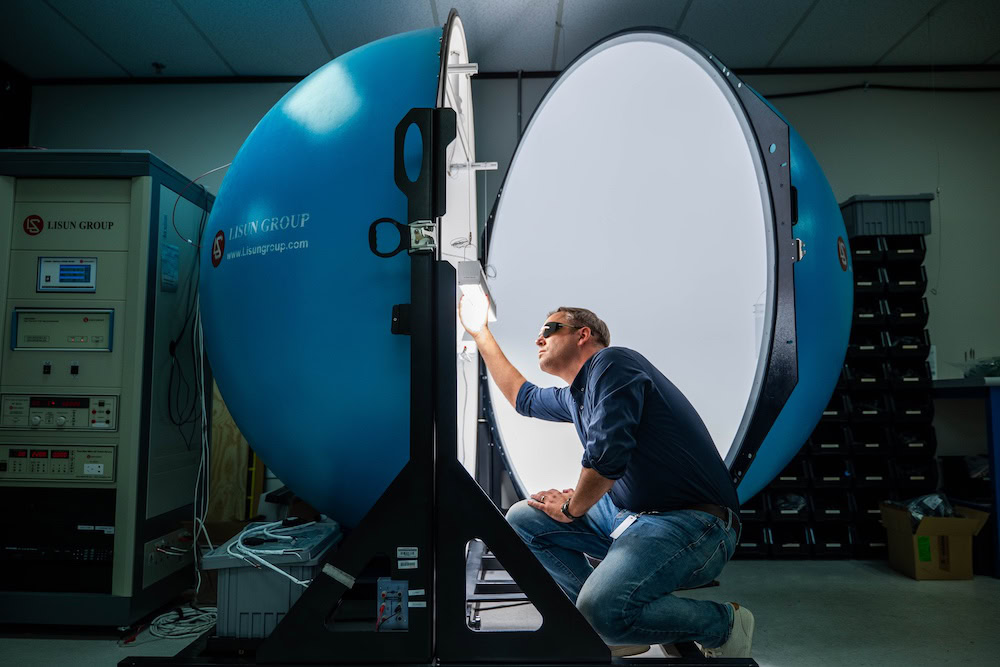
The final stage focuses on functional and light-output testing to validate that the manufactured product reflects its original design intent. Fluence tests products to confirm that they operate correctly and deliver the expected lighting performance before they are shipped. This supports the company’s goal of driving toward zero out-of-box failures and ensuring that products are ready to work when they reach the customer.
For a commercial grower, a fixture must do more than turn on. Its output must align with the intended lighting design and perform consistently alongside the other fixtures installed throughout the room. Functional testing helps verify that the completed product operates as designed, while light-output testing helps confirm that the manufactured fixture delivers the expected performance established during product development. Together, these final checks connect engineering intent with the product that ultimately arrives at the cultivation facility.
Looking Beyond the Initial Cost
Lighting manufacturers operate in a market where cost is an important consideration. Growers are under pressure to manage capital expenses, control operating costs and justify each investment within the facility, but the initial purchase price is only one part of the long-term value of a commercial lighting system.
Some manufacturers may place greater emphasis on reducing product cost. Fluence and Signify take a broader view that considers how the product is designed, manufactured and expected to perform throughout its operating life. Signify’s lighting history, including the Philips legacy, extends back more than a century. That experience has helped shape an approach to product development that places significant emphasis on engineering, process control, compliance and long-term reliability.
The four stages of Fluence product testing reflect that philosophy. Critical to Quality requirements define what must be controlled, simulation testing evaluates how the product responds to its intended environment, compliance testing addresses the requirements of the markets where it will be used, and functional and light-output testing confirm that the finished fixture reflects its manufacturing intent.
For commercial growers, rigorous testing ultimately means greater confidence that the lighting system has been developed with consistency, reliability and long-term performance in mind. It is one more way Fluence works to reduce uncertainty before a product ever reaches the grow.