Operational Costs Are Reshaping Commercial Cultivation
Across commercial cultivation, operational efficiency is becoming one of the defining factors separating profitable growers from struggling operators. Rising electricity costs, labor pressures, tighter margins, and increasing competition are forcing cultivation teams to evaluate every part of the production environment more carefully.
According to the 2025 State of the Cannabis Lighting Market report, “managing energy costs” ranked as the top lighting-related challenge among commercial cultivators for the fifth consecutive year. At the same time, 58% of growers cited energy efficiency as one of their top lighting purchasing considerations.
That pressure is accelerating the industry’s shift toward more advanced lighting strategies. While LED adoption continues to grow rapidly, growers are increasingly exploring technologies that go beyond simple fixture replacement. In fact, 43% of commercial indoor and greenhouse growers reported they are actively exploring tunable spectrum and dynamic lighting strategies.
The broader shift is clear. As of 2025, nearly 80% of growers now use LEDs in flowering environments, compared to just 15% in 2016. But the conversation around lighting has evolved significantly over the past decade. Early adoption focused primarily on reducing energy consumption. Today, growers are using modern lighting systems to improve operational flexibility, simplify facility management, increase production consistency, and optimize long-term cultivation economics.
As Fluence Director of Technical Services Chris Bezuyen noted in Cannabis Business Times, “Some lighting stories are bigger than lighting.” Increasingly, lighting is becoming part of a much larger operational strategy.
Why Lighting Is More Than an Energy Decision
For years, lighting decisions were largely evaluated through a narrow lens: fixture wattage, upfront cost, and fixture efficacy. While those factors remain important, growers are now asking broader operational questions tied directly to scalability and profitability.
How many fixtures are required to achieve target light levels? How much maintenance is tied to keeping legacy systems operational? Can lighting strategies support evolving cultivation methods without requiring major infrastructure changes? How efficiently can growers manage multiple rooms, crop stages, or seasonal production shifts?
Modern high-efficiency LED systems are helping growers rethink those questions. Higher efficacy fixtures deliver more usable light per watt while reducing many of the maintenance demands associated with legacy lighting technologies. Commercial HPS systems, for example, continue to carry relamping costs, labor requirements, and gradual output degradation over time. According to Fluence’s retrofit research, HPS bulbs can lose approximately 1% of output for every 1,000 hours of runtime, while annual maintenance costs can approach $60 per fixture each year. For facilities operating hundreds of fixtures, those maintenance expenses alone can add up to thousands—or even tens of thousands—of dollars annually.
How High-Efficiency Lighting Reduces Operating Costs
Electricity remains one of the largest ongoing operational expenses for greenhouse and indoor cultivation facilities. Improving fixture efficiency directly impacts long-term operating economics, particularly in facilities running extended photoperiods across multiple flower rooms or greenhouse zones.
According to a Sacramento Municipal Utility District study referenced in the Fluence Indoor LED Retrofit Guide, LED retrofits reduced lighting-driven electrical costs by 34%, while total electrical costs decreased by as much as 25% when HVAC-related reductions were included.
But efficient lighting strategies are increasingly doing more than simply lowering utility bills. Many growers are now using higher-output LED systems to maximize production within existing electrical infrastructure rather than expanding facility footprint or adding additional power capacity.
Research and commercial cultivation data continue to demonstrate the relationship between light intensity and production potential. According to Fluence’s retrofit research, a 1% increase in photosynthetically active radiation (PAR) can correspond to approximately a 1% increase in harvestable product under optimized cultivation conditions. While outcomes vary based on genetics, environmental control, and operational execution, many growers are leveraging modern LEDs to push higher light intensities more efficiently than traditional HPS systems can achieve.
Simplifying Operations Through Modern Lighting Systems
One of the most significant operational advantages of modern LED systems is simplification.
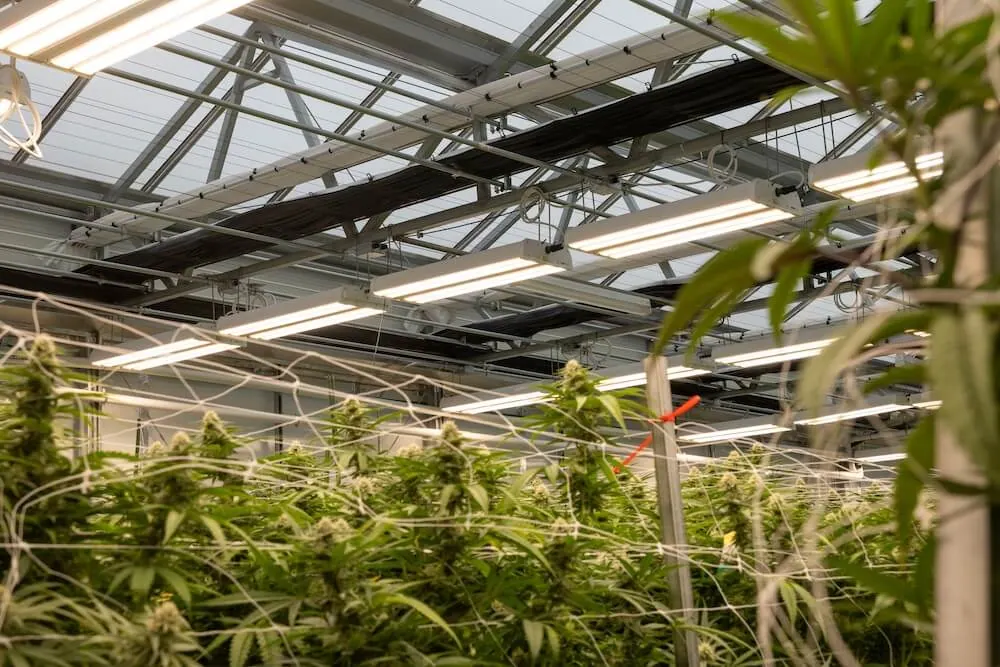
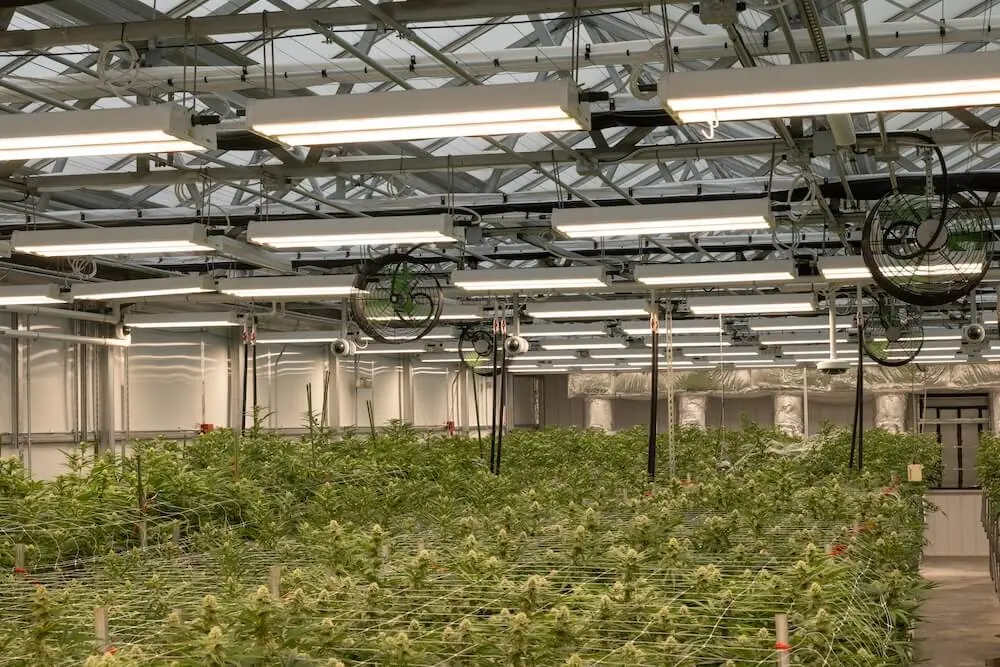
Longer fixture lifespans reduce maintenance interruptions and eliminate ongoing relamping cycles. Integrated dimming and centralized control systems allow growers to adapt lighting strategies more precisely across changing environmental conditions and crop stages. Higher-output fixtures can also reduce total fixture count in some applications, simplifying installation planning and long-term operational management.
For greenhouse growers, this flexibility becomes especially valuable during seasonal transitions. In a Cannabis Business Times feature on advanced LED deployment strategies, Ascend Wellness Holdings reported using Fluence RAPTR fixtures to maintain higher target light levels during winter production months. According to Director of Greenhouse Cultivation William Slayden, the facility was able to maintain 1,200–1,500 µmol/m²/s under LEDs during winter periods, compared to roughly 800–1,000 µmol/m²/s under HPS rooms.
The facility also reported yield improvements ranging from 5 to 12 grams per square foot in LED-equipped rooms.
Dynamic Lighting Strategies Are Expanding Operational Flexibility
As cultivation technology continues to evolve, many growers are moving beyond static lighting strategies entirely.
Modern systems now allow operators to adapt lighting conditions based on crop stage, environmental conditions, seasonal sunlight variation, and production objectives. Integrated dimming, tunable spectrum capabilities, and dynamic lighting strategies are giving growers far more operational flexibility than traditional fixed-output systems allowed.
According to the 2025 State of the Cannabis Lighting Market report, 93% of commercial indoor and greenhouse cultivators now use some form of lighting control system. Growers are increasingly integrating lighting, environmental controls, and automation systems to create more responsive cultivation environments focused on precision, consistency, and efficiency.
This shift is particularly important for facilities seeking long-term adaptability. In the same Cannabis Business Times article, Cannara Biotech described flexibility as one of the primary drivers behind its transition to dimmable LED systems. By deploying adjustable lighting strategies, the company was able to create rooms capable of supporting both vegetative and flowering production rather than dedicating spaces to a single purpose.
That operational flexibility allows growers to adapt workflows, improve room utilization, reduce labor movement, and futureproof facilities as cultivation strategies continue to evolve.
Operational Efficiency Is Becoming a Competitive Advantage
As cannabis cultivation markets mature, operational efficiency is increasingly becoming a competitive advantage rather than a secondary consideration.
Growers today are evaluating lighting decisions through a much broader lens than fixture efficacy alone. They are looking at maintenance demands, production scalability, operational consistency, infrastructure efficiency, environmental control, and long-term cost management.
Modern lighting systems are now playing a central role in that conversation. While reducing electricity usage remains important, the broader operational value often comes from improving flexibility, simplifying workflows, increasing precision, and creating more resilient cultivation environments over time.
Increasingly, the lighting story is no longer just about lighting. It is about building a more efficient cultivation operation overall.