When light levels increase, how does a cannabis crop adapt and thrive? In this blog, you will learn the key elements needed to prepare a greenhouse environment for cannabis cultivation. In order to successfully cultivate cannabis, you will need to understand how cannabis grows, the relationship between environmental variables and how to effectively manage vapor pressure deficit (VPD) at different energy levels.
Culture de cannabis à des fins commerciales
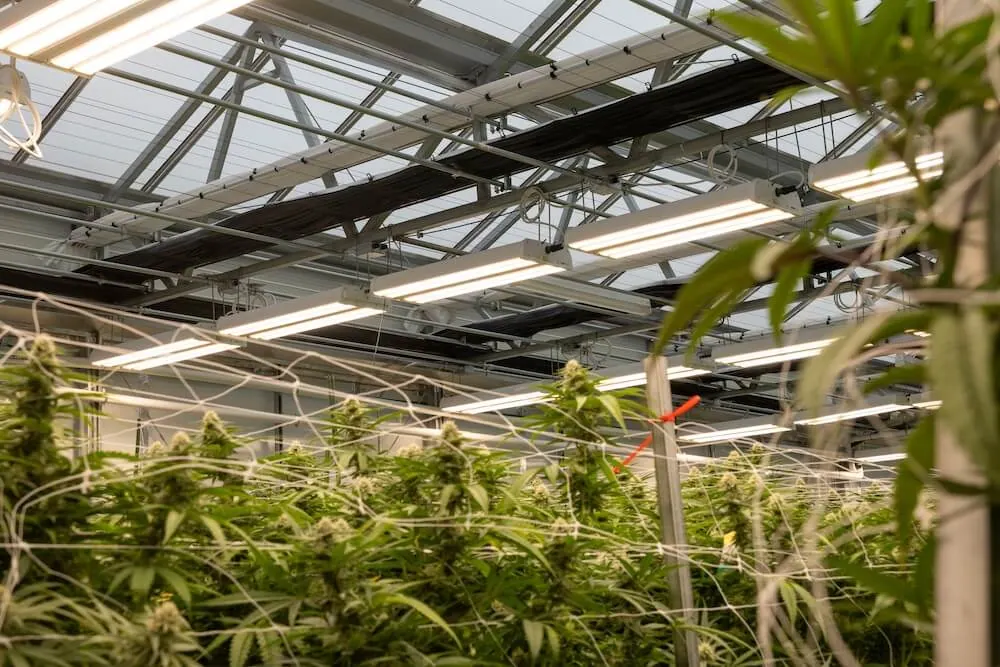
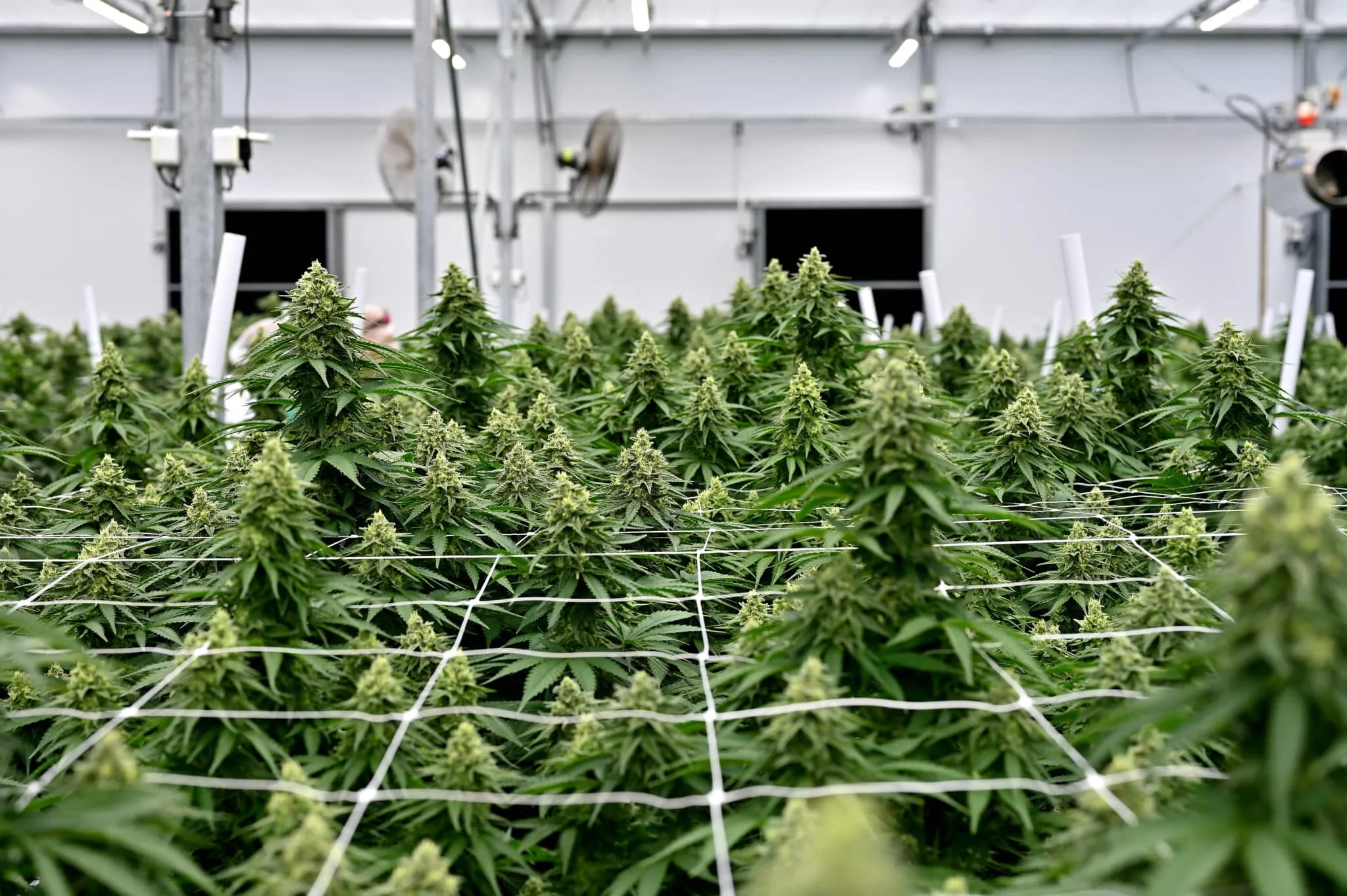
Cannabis cultivation requires optimal greenhouse environments, which include proper light intensities, HVAC requirements and VPD management. For the purposes of commercial cultivation, it’s important to know that cannabis is a “high DLI, short day” flowering plant.
Daily Light Integral (DLI) is a metric which analyzes the cumulative amounts of light photons a plant’s canopy absorbs over the duration of the photoperiod. This means DLI is the accumulative measurement metric, as opposed to an instantaneous measurement, like PPFD. A photoperiod is the period of time each day an organism receives illumination. Acclimating cannabis to light is a fundamental aspect of a commercial grow environment.
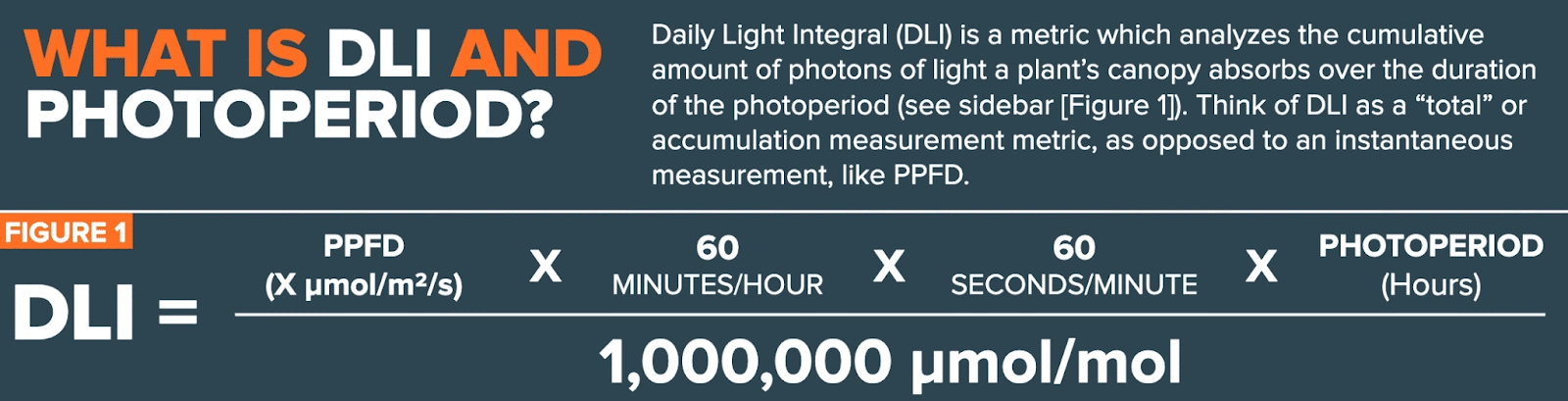
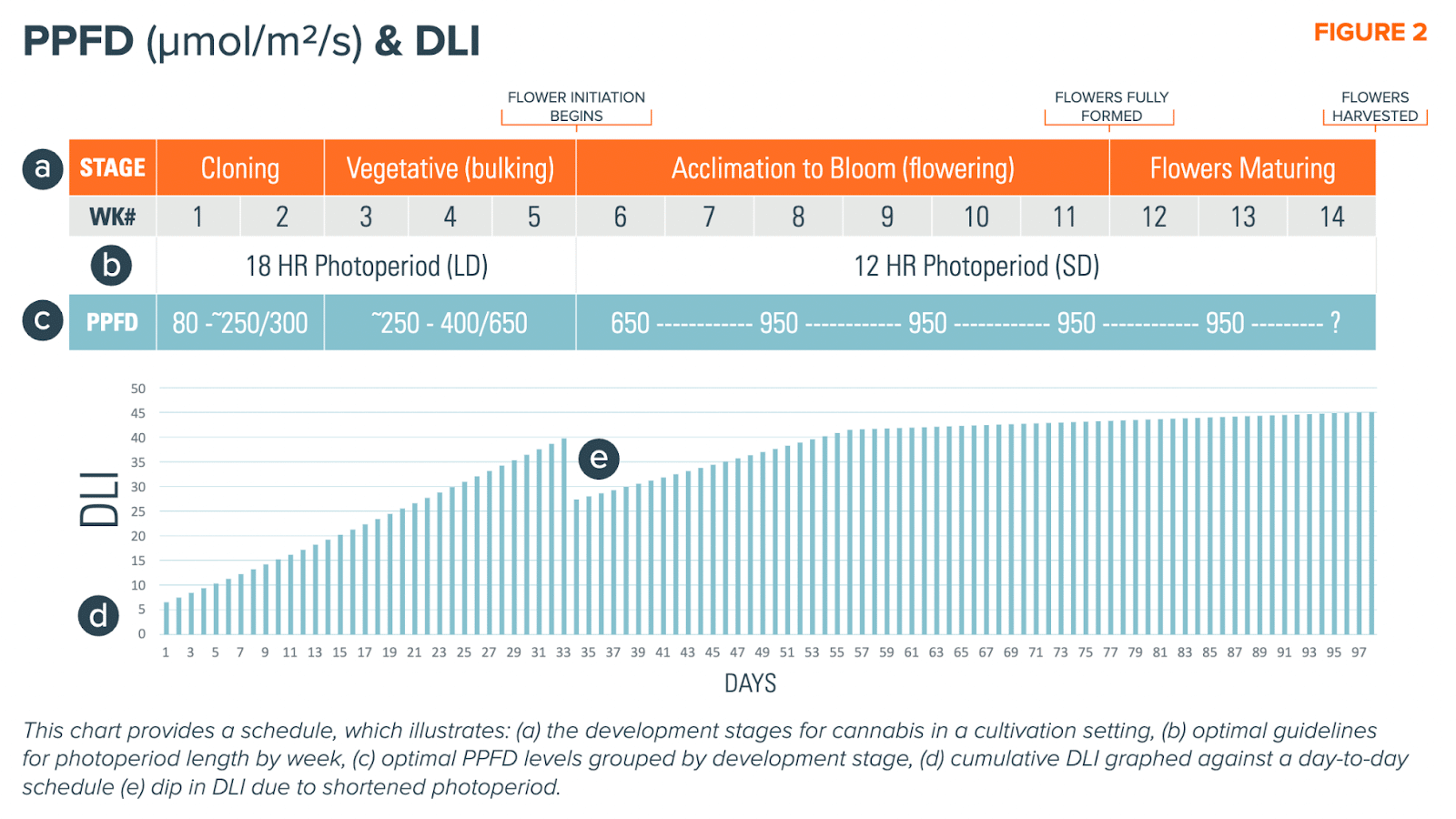
Cannabis has a high DLI because it works harder and is able to use light to drive more photosynthesis than most plants. In nature, cannabis also flowers during fall-winter months due to the longer dark periods of 12-hours or more. Key takeaway – A sufficient photoperiod schedule for cannabis cultivation consists of a long 18-hour photoperiod application during beginning stages (stock production, propagation and vegetative stages) followed by a short 12-hour photoperiod during the flowering stage.
Conseil de culture :
Si vous envisagez d'installer une serre, il est important de savoir que l'intensité lumineuse reste constante à l'intérieur, alors qu'elle atteint son maximum à l'extérieur lorsque le soleil atteint son zénith à midi.
Comment programmer la croissance du cannabis par photopériode (graphique)
Comprendre la relation entre les variables environnementales
There are a variety of environmental variables that play an essential role in cannabis cultivation.
Heating, ventilation and air conditioning (HVAC) and vapor pressure deficit (VPD) are two important variables that greatly impact the cultivation of cannabis. In this section, Dr. Nadia Sabeh, president and founder of Dr. Greenhouse Inc., provides advice on how to manage HVAC paired with high-intensity lighting and the effects of VPD on cannabis plants.
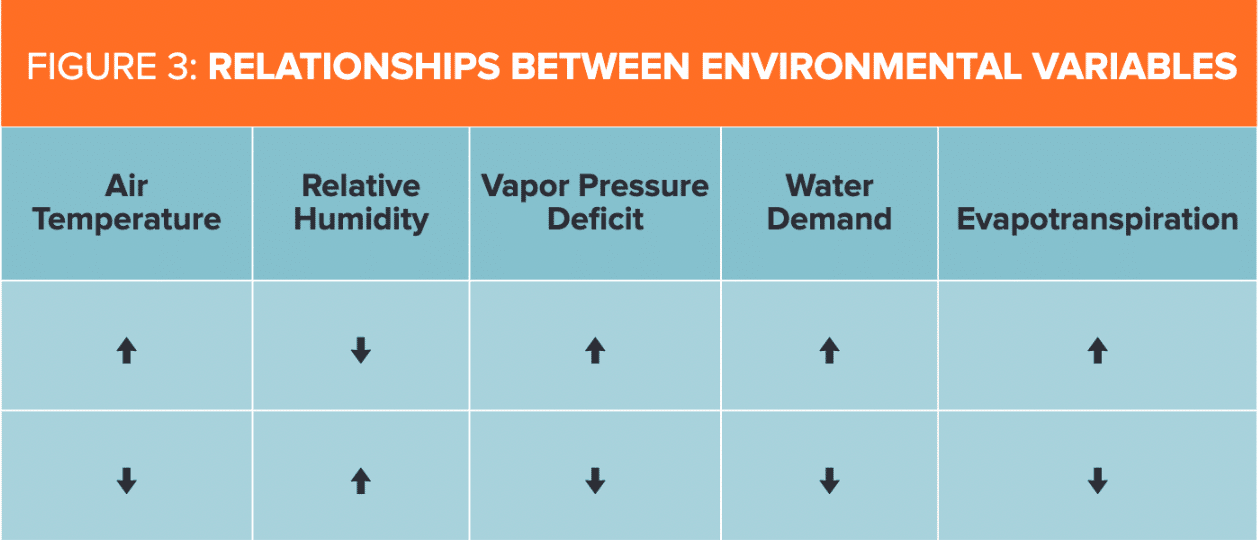
HVAC requirements change intricately when you increase light intensities in your environment. Dr. Sabeh recommends calculating the thermal conditions of a facility by addressing the facility size, heating sources and moisture sources. This analysis ultimately leads to the management of VPD, which is the measurement of the difference between saturation vapor pressure inside cells and the vapor pressure of a room’s air at a given temperature and humidity level. VPD affects how plants cool themselves by releasing moisture into the air, otherwise known as transpiration. When VPD is high, transpiration is rapid, in comparison, when VPD is low, transpiration is slow. Transpiration critically affects the diurnal balance of heat and moisture in the cultivation space (figure 3).
Conseil de culture :
Lorsque le DPV est très faible, un film de rosée peut se former sur les plantes, ce qui constitue un milieu propice à l'apparition de moisissures et de maladies. Lorsque le DPV est très élevé, les plantes utilisent davantage d'eau pour la transpiration, ce qui a une incidence sur l'irrigation et l'utilisation des nutriments.
Gérer efficacement le DPV grâce à l'énergie sensible et à l'énergie latente
Under higher light intensities, targeting a specific vapor pressure deficit is an effective strategy for controlling transpiration and overall plant deployment. However, to effectively manage VPD, it is important to understand the dynamics of the grow room environment, including how and when heat and moisture are generated. Below are the important variables Dr. Sabeh calculates to better understand VPD management.
- L'énergie sensible est la forme de chaleur que les humains et les plantes peuvent sentir (ou ressentir). Elle est mesurée à l'aide d'un thermomètre traditionnel et est exprimée en tant que "température sèche".
- L'énergie latente est la chaleur associée aux changements de phase entre un gaz, un liquide et un solide. La chaleur latente est piégée par l'eau lorsqu'elle s'évapore et est libérée par la vapeur d'eau lorsqu'elle se condense en liquide.
- Le changement de phase se produit lorsqu'un liquide gagne de l'énergie (généralement de la chaleur) et s'évapore en gaz.
- L'enthalpie est la quantité totale de chaleur dans un volume donné. Pour une salle de culture, l'enthalpie est la somme de la chaleur sensible et de la chaleur latente.
Conseil de culture :
Les appareils à LED produisent moins de chaleur que les lampes à décharge à haute intensité (HID). Cela signifie souvent que l'espace de culture a besoin de plus de déshumidification et de moins de refroidissement par chaleur sensible. Dans l'ensemble, Nadia estime que les coûts totaux d'électricité sont inférieurs de 5 à 10 % lorsque l'on utilise des luminaires à LED.
En résumé, il y a quelques éléments essentiels à comprendre pour une bonne culture du cannabis. La première étape consiste à comprendre la période de croissance optimale d'un plant de cannabis. Ensuite, vous devrez comprendre vos variables environnementales entre HVAC et VPD. Enfin, il est important de gérer efficacement le DPV en variant les intensités lumineuses. Si vous souhaitez moderniser votre serre avec des lumières LED, contactez les experts de Fluence pour obtenir de l'aide.