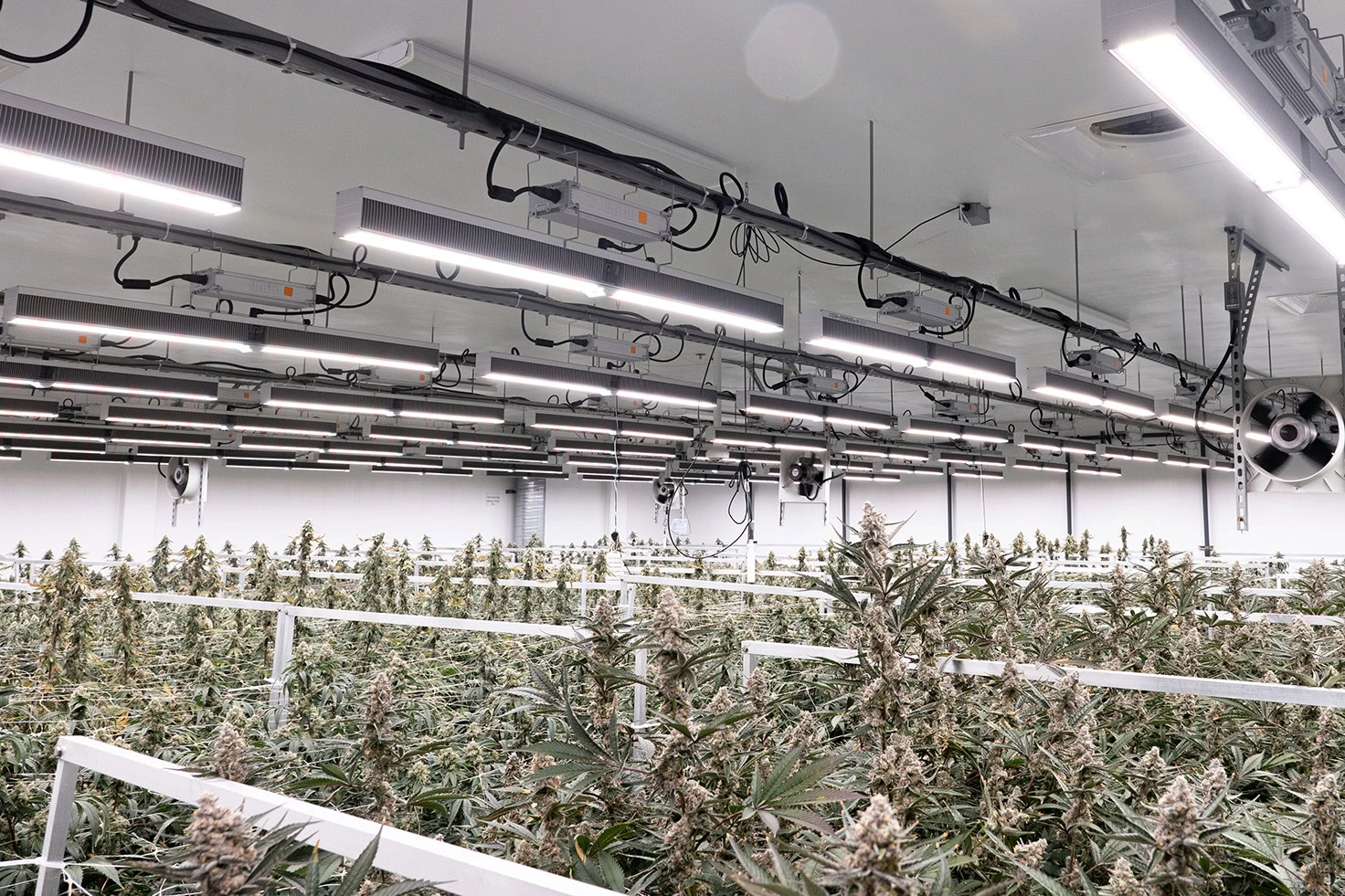
Lors de la MJBizCon 2024, le Dr David Hawley, responsable de la recherche et du développement chez Fluence, a présenté des conclusions complètes sur l'éclairage intercanopée (ICL) et l'éclairage sous-canopée (SCL) dans la culture du cannabis. Sa présentation visait à démystifier ces techniques d'éclairage et à expliquer les messages contradictoires sur le marché quant à leur efficacité.
Comprendre les principes de la technologie ICL/SCL
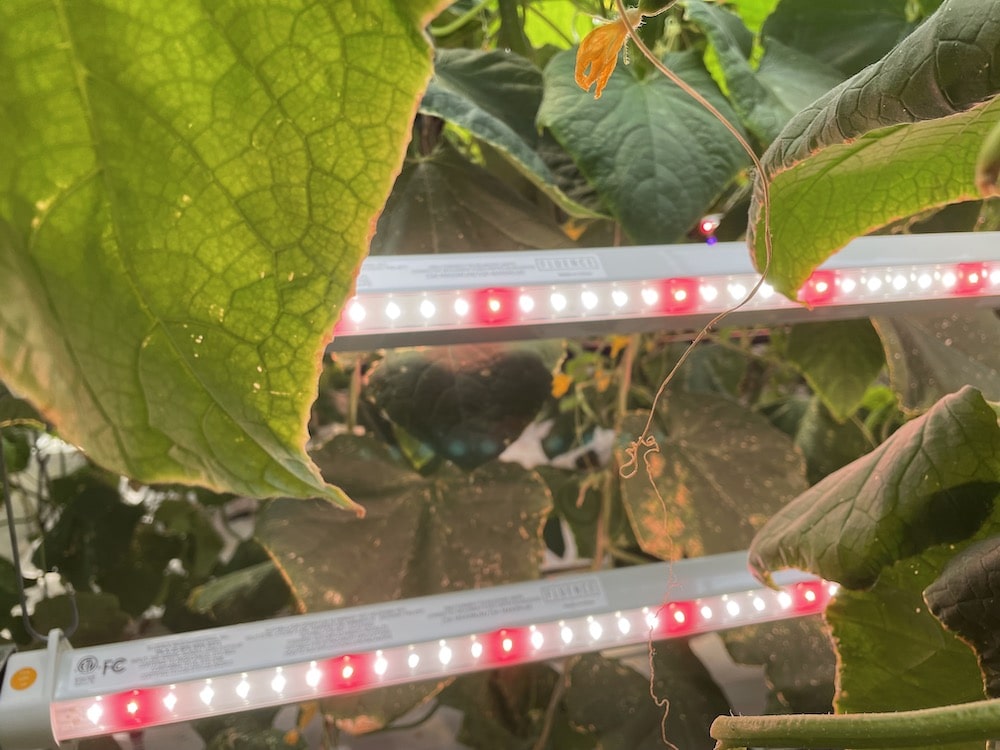
L'ICL et le SCL consistent à ajouter ou à redistribuer de la lumière à l'intérieur de la canopée du cannabis, soit en complétant l'éclairage supérieur, soit en redistribuant une partie de la lumière supérieure vers les zones inférieures. Le principe de l'ICL/SCL est que les feuilles agissent comme des panneaux solaires dans l'usine de la plante. Dans les canopées denses ou hautes, les feuilles inférieures ne reçoivent souvent pas assez de lumière pour contribuer à la photosynthèse, ce qui représente un potentiel gaspillé. En apportant de la lumière à ces zones, l'objectif est d'augmenter l'activité photosynthétique et d'améliorer le développement des bourgeons dans l'ensemble de la plante.
Avantages de l'éclairage ICL
Fluence’s research revealed several key findings about ICL’s impact. When used as supplemental lighting (adding energy), yields increase proportionally. However, when the same total energy is redistributed between top and subcanopy lighting, total yield generally remains unchanged. The relationship between light intensity and yield remains largely linear up to high intensities, reaching 2500 μmol/m²/s for some cultivars.
Consistently, ICL improved bud grade, with B-grade buds becoming A-grade and C-grade becoming B-grade. It also enhanced bud uniformity in terms of mass and volume, though it showed no significant impact on THC content or other chemical properties.
The research demonstrated that ICL can help prevent morphological issues that occur at high light intensities, with fewer instances of re-vegging and fox tailing compared to equivalent top-lighting. Regarding spectrum considerations, Hawley emphasized that the same principles apply to ICL as top lighting. Too much red light can cause photobleaching, with cultivar-dependent sensitivity, while white-dominant spectra generally perform well.
Comparaison entre l'éclairage inter-canopée et l'éclairage sous-canopée
When comparing ICL to SCL, the research showed that SCL delivered approximately 7.1% better yields than ICL in standard North American growing conditions. However, the choice between ICL and SCL heavily depends on cultivation style. Tall plants benefit more from ICL, while short plants (sea of green) benefit more from SCL. Row crops with significant spacing may not benefit from either approach.
Dr. Hawley attributed market confusion about ICL effectiveness to several factors. Experimental design varies significantly, with some studies comparing additional ICL to existing top light versus redistributing the same energy. Measurement methodology also creates confusion, as PPFD (Photosynthetic Photon Flux Density) measurements can be misleading for ICL, while PPF (Photosynthetic Photon Flux) provides more accurate comparisons. Additionally, variables such as plant spacing, canopy architecture, growing style, HVAC systems, and genetics all affect ICL effectiveness but aren’t always considered in studies.
Lignes directrices de mise en œuvre fondées sur la recherche
For most growers, Hawley recommended adding top light rather than implementing ICL/SCL, citing similar yield benefits with less complicated infrastructure, easier maintenance, and fewer obstacles to labor activities. However, ICL/SCL might be worth considering for operations with tall plants, those seeking improved bud grade, dealing with dense canopies, or operating in specific facility configurations. When implementing ICL/SCL, growers should focus on creating uniform light distribution, consider total energy rather than just light intensity at specific points, match spectrum to cultivation goals and genetic sensitivity, and account for facility-specific factors.
Dr. Hawley concluded by emphasizing that while ICL and SCL can provide benefits, growers should carefully evaluate their specific situation and needs before implementation, as the technology isn’t universally advantageous despite marketing claims suggesting otherwise.