Introduction
Over the last 8 years, the use of a white light spectrum has become the status quo for cannabis cultivation. Growers worldwide have enjoyed high yield, high flower quality, good workplace ergonomics, and easy scouting under white light. While tweaks to this formula have come in and out of style, the core spectrum led by Fluence’s R4 has remained a reliable constant in a dynamic industry. With increasing commoditization of cannabis, growers aren’t earning as much as they used to, and are looking for ways to reduce operational costs to improve profit margins. To this end, Fluence has identified new spectra and lighting strategies to help ease the financial burden of lighting.
History
Theory and early findings: white light grows better cannabis
Historically, Fluence was famously known as a “white light” company. Since approximately 2017, the optically white “PhysioSpec Indoor” spectrum, now known simply as the “R4” spectrum, has dominated the global cannabis lighting landscape and served the template competitors have followed in designing their cannabis spectra. R4 was designed on the theories of greater canopy penetration and secondary metabolite expression than what would be achieved with a less balanced spectrum. In early scientific studies, comparing R4 to spectra with 60% red, 80% red, and 40% red with a bit of supplemental far-red, the theory that R4 would yield higher, presumably because of superior canopy penetration, was supported. Across the three cultivars tested, two yielded similarly across the tested spectra, and one yielded 17% more bud mass with R4. This result was statistically significant after three replicates. Based on these results, we amplified our messaging that white light was the superior solution for cannabis cultivation.
Confounding factors: Across many cultivars and cultivation styles, red-rich spectra yield the same as white
Studies that followed continued to compare the effects of varied red content on different cultivars and with different cultivation styles. We learned that, while there are some cultivars that did seem to favor white light, the average yield and secondary metabolite response across all the cultivars tested didn’t significantly differ based on red fraction. To this day, we speculate that the added benefits that do occasionally occur when growing with white light may be a product of using white light with more dense canopies, but we have yet to definitively test this.
Discovery: Red induces photobleaching

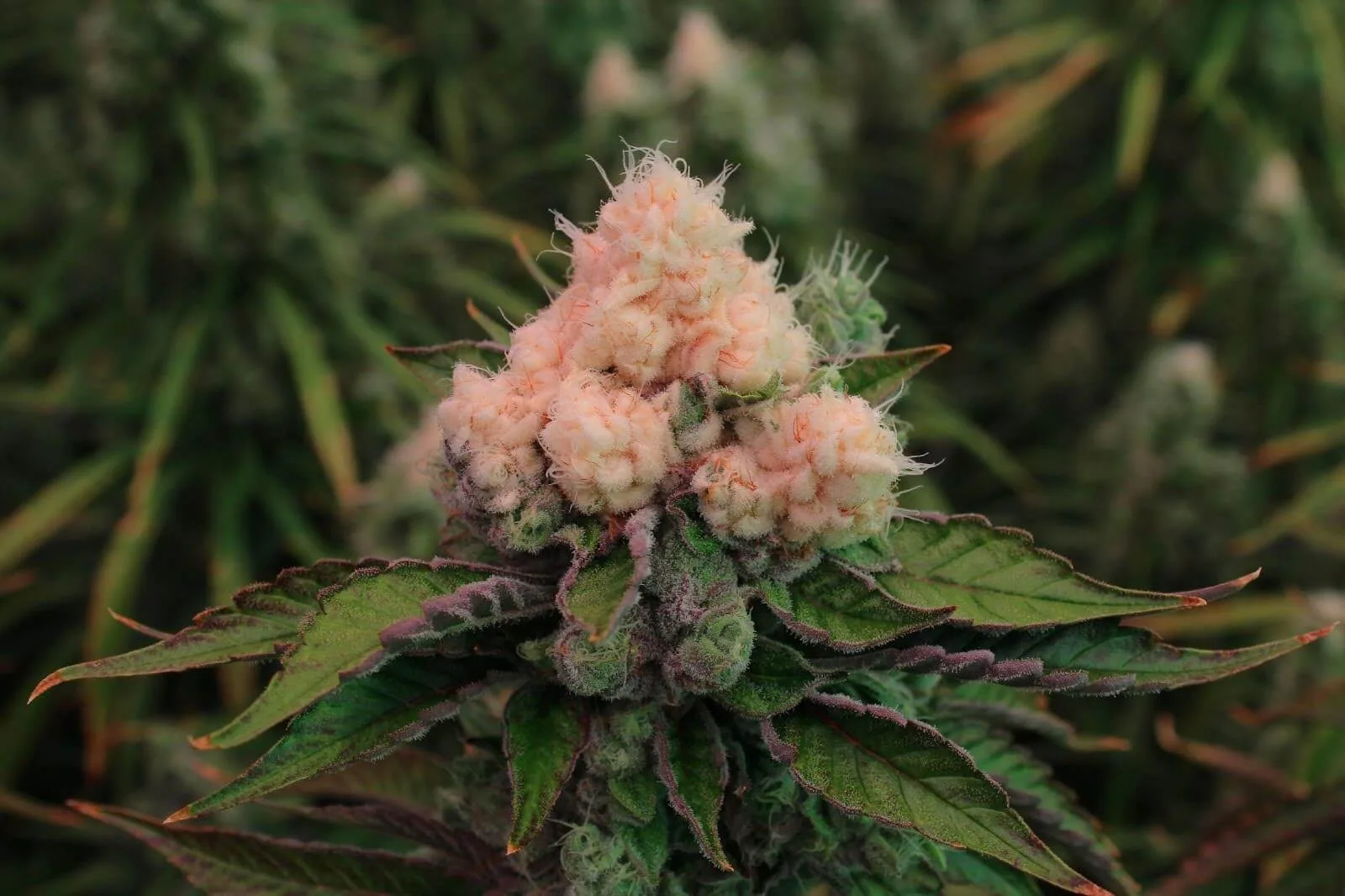
Throughout these early studies, an unexpected trend was observed that we hadn’t initially set out to quantify: as the fraction of red light increased, so too did the number and severity of upper inflorescences turing white. Today, this phenomenon is commonly known as “photobleaching” or “white tipping”, though neither moniker is an accurate descriptor of what is biochemically happening to the plant.
Characterizing red-light thresholds to develop a more efficacious lighting solution
Photobleached flower is generally undesirable in the market. Simultaneously, we know that growers are likely to be seeking lighting solutions with improved electrical efficiency to reduce their operational expenses (OPEX) while maintaining quality and yield. In LED-based lighting, the efficacy of converting electricity to photons is primarily driven by the amount of red in a given spectrum. Therefore we sought to identify the upper limit of red photons we could use in a flowering spectrum without inducing photobleaching. We’ve determined this threshold to be approximately 500 µmol·m-2·s-1, plus or minus 100 µmol·m-2·s-1 depending on the cultivar. This threshold indicated the possibility of only a modest increase in red content, and thus system efficacy, over our pre-existing R4 spectrum, at the photosynthetic photon flux densities (PPFD) at which most growers were operating.

Red in Veg
Vegetative development is, by definition, not developing floral material. The risk of directly inducing photobleaching with too much red light is therefore non-existent. To ensure that high-red levels during veg do not have a downstream consequence to flower development, we executed studies comparing R4 and R8 spectra deployed during veg. Across all cultivars tested, we observed no significant differences in vegetative development or downstream flower development, considering canopy architecture, flower yield, and chemistry.
Red in Flower
Growing for biomass / extract
Because high-red spectra and balanced white spectra achieve comparable yields, cannabinoid, and terpene profiles, either are suitable for raw biomass production that will be going to extraction. The end user never sees the flower, photobleached or not, and market value of the extract will be unaffected.
Growing for Flower
If minimizing instances of photobleaching is paramount and system efficacy is not a concern because you have very low electrical utility rates, Fluence’s R4 continues to be the optimal cannabis lighting solution. If, however, you want to reduce the likelihood of photobleaching while also reducing OPEX, there are now strategies for increased red fraction, depending on your production environment, genetics, and target PPFDs.
Growing in a greenhouse
If you are only supplementing a relatively low PPFD because the sun is your primary light source, you may be able to use a spectrum with a higher red content than R4. For instance, if the maximum supplemental PPFD you’ll use throughout the entire year is 450 µmol·m-2·s-1, you can use Fluence’s R8 spectrum. The R8 spectrum is approximately 80% red, which means you’d be applying a supplemental red flux density of only 360 µmol·m-2·s-1, below the red flux threshold where most cultivars are sensitive to photobleaching. Exactly how much red is optimal for your application would be determined by the cultivars you’re growing, how much flexibility you want to have with genetics, and where you are in the world. I and my team are happy to guide you through this assessment, if desired.

Sole-source indoor lighting
Like supplementing PPFD in a greenhouse, if the PPFD you’re targeting is relatively low, you can very likely use a higher-red spectrum without inducing photobleaching. If, however, you are growing at PPFDs commonly practiced in 2026 in North America, at or above 1000 µmol·m-2·s-1, a higher-red spectrum cannot be used throughout flower development without significant risk of photobleaching. However, through continued research, Fluence has identified specific periods during flower development that the flowers are more or less sensitive to red-induced bleaching. By dynamically modulating the amount of red in the spectrum to correspond with these periods, Fluence now offers a solution called “T48” that allows growers to achieve the same high yields and quality without photobleaching as R4, but with a significantly reduced OPEX. This dynamic spectrum schedule can be applied automatically using Fluence’s GrowWise Control System (GWCS) or can be manually implemented with 2-channel dimming.
Red vs White: Which should you choose?
Implications beyond crop performance
If you prefer the workplace ergonomics and ease of crop scouting using white light and / or you’re not concerned about the efficacy of the spectrum, use R4 throughout veg and flower development.
For Veg
We recommend using the R8 spectrum. It will save you a bit of money and plant development won’t significantly differ from plants grown under R4.
For flower
If you aren’t concerned about OPEX and want the simplest solution with the lowest risk of photobleaching, use the white R4 spectrum. If you want to maintain the same high quality and yield without photobleaching, use T48.
For biomass / extract
Use R8.
Have we changed our thinking on red light?
We, at Fluence, used to believe that a whiter light, especially our R4 spectrum, was the best tool for the job in most cannabis grows. With more research, we’ve learned that the benefits of white light are not as all-encompassing as we once believed and consequently have changed our narrative over the years. This is, and always will be, the nature of a company led by science. As we learn more and discover better ways of doing things, we develop new and better products and share what we’ve discovered. I’m hopeful that, in a year or two from now, I’ll be able to write a new article that builds upon and refines what I’ve said here.
1 A sensory panel at Wageningen University found consumers could not tell the difference in aroma between bleached and unbleached flower. I am unaware of a formal sensory study has been conducted comparing the consumption experience of bleached and unbleached flower, but such a thing would be very interesting.
2 Exceptions exist, but they are the outliers. For example, we’ve cultivated cv. ‘San Fernando Valley’, a.k.a. ‘SFV OG’ at 1100 µmol·m-2·s-1 with the R8 spectrum with no photobleaching.