LED grow lights are the better choice for cannabis cultivation, though understanding why requires a closer look at where fluorescent lighting falls short. While fluorescent lighting can support early plant stages, LED grow lights deliver higher light intensity, improved spectrum control, greater energy efficiency, and better scalability, making them the preferred choice for commercial and long-term cannabis production.
LED vs. Fluorescent Grow Lights: Key Differences at a Glance
| Factor | LED Grow Lights | Fluorescent Lights |
|---|---|---|
| Energy Efficiency | High | Low |
| Light Intensity (PPFD) | High and uniform | Limited |
| Spectrum | Broad, application-specific | Narrow, fixed |
| Heat Management | Low radiant heat at canopy | Heat introduced near plants |
| Lifespan | Long (minimal degradation) | Short (frequent replacement) |
| Scalability | Designed for commercial scale | Limited to small or early-stage use |
Spectrum Quality: Matching Light to Plant Needs Classified
Light spectrum plays a critical role in how cannabis plants grow, develop, and express their genetic potential. Fluorescent grow lights typically emit a narrow spectrum with pronounced peaks, often concentrated in the blue range, making them suitable for seedlings and vegetative growth but less effective during flowering.
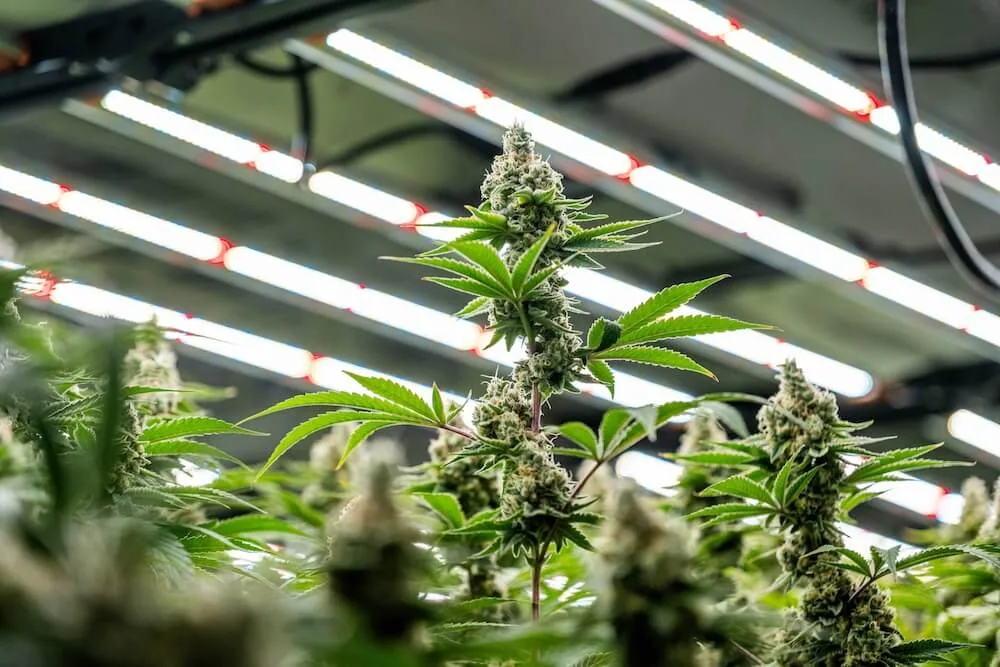
Modern LED grow lights are designed with broad, application-specific spectra that support the full cannabis lifecycle. These tailored spectral profiles help drive balanced plant development, promote efficient photosynthesis, and support cannabinoid and terpene production during flowering.
Unlike fluorescent bulbs, which rely on fixed phosphor coatings, LED fixtures allow precise spectral tuning based on plant stage and cultivation goals. This flexibility enables growers to optimize light delivery without relying on multiple fixture types or supplemental lighting.
Light Intensity & PPFD: Why Fluorescent Lighting Falls Short
Light spectrum matters—but light intensity and delivery ultimately determine whether cannabis plants can reach their full potential.
Fluorescent lighting systems, including T5 and CFL fixtures, were designed for low intensity applications. While they can support early-stage growth, they struggle to deliver the photosynthetic photon flux density (PPFD) required for high-quality flowering.
Cannabis is a high-light crop. During flowering, commercial facilities target PPFD levels that fluorescent systems cannot reliably maintain across an entire canopy. To compensate, fixtures must be positioned extremely close to plants, resulting in uneven coverage, limited canopy penetration, and inconsistent development at lower bud sites.
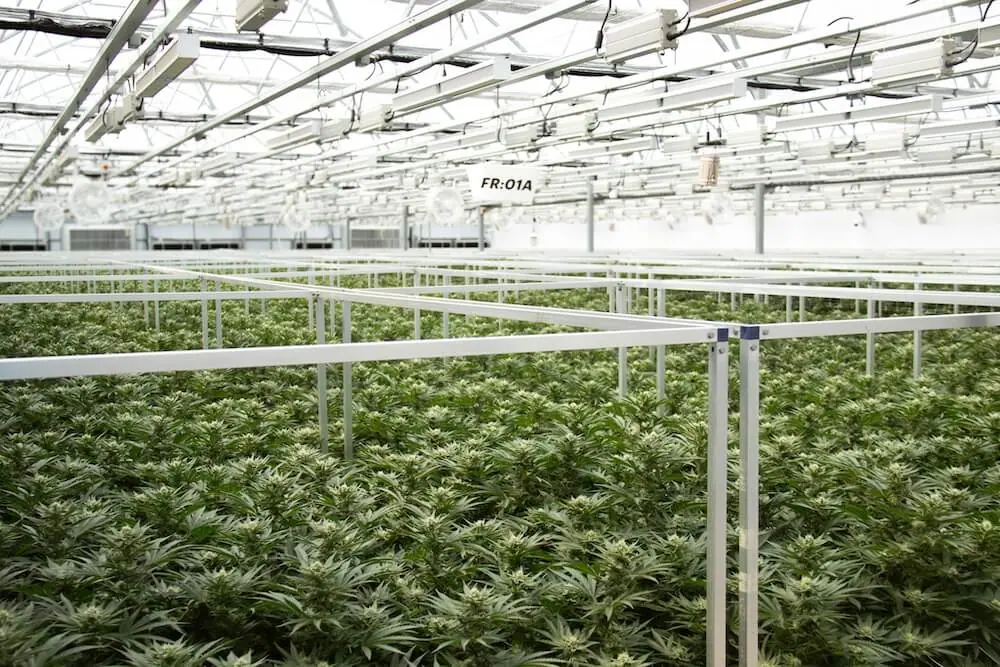
Purpose-built LED grow lights are engineered to deliver high, uniform PPFD across larger cultivation areas. This consistency supports more even flower development, improved yield potential, and predictable results from cycle to cycle.
Thermal Management & Environmental Control
As light intensity increases, heat management becomes a defining factor in cultivation efficiency.
Fluorescent fixtures convert a significant portion of energy into heat and must be placed close to the canopy to achieve usable intensity. This introduces heat directly into the grow zone, creating hot spots and uneven temperature distribution—particularly in dense flowering canopies.
LED grow lights manage heat differently. Designed with integrated thermal management, LEDs direct heat away from the canopy, allowing growers to maintain more stable temperatures and tighter control over vapor pressure deficit (VPD). This improves plant comfort, reduces HVAC strain, and supports consistent environmental conditions across the room.
Fluorescent fixtures also introduce a physical safety risk in cultivation environments. Because fluorescent lamps are made of glass and must be positioned close to the canopy, accidental breakage during routine maintenance or plant movement can create hazards for growers. Broken glass in active grow rooms increases cleanup complexity, contamination risk, and potential injury, especially in high-density production environments.
Consistency & Scalability: Where Fluorescent Lighting Breaks Down
Consistency is one of the biggest challenges in cannabis cultivation—and one of the most important.
Fluorescent lighting systems often require workarounds such as increased fixture density, frequent bulb changes, or constant height adjustments. These variables introduce inconsistency from room to room and cycle to cycle, making it difficult to standardize results.
Fluorescent bulbs also degrade quickly, reducing light output over time and increasing maintenance demands. In scaled environments, this adds labor, downtime, and uncertainty.
LED grow lights are built for repeatability. With long operating lifespans and stable output, LEDs allow growers to standardize room designs, replicate cultivation recipes, and scale production with confidence—whether across multiple rooms or multiple facilities.
Frequently Asked Questions: LED vs. Fluorescent Grow Lights for Cannabis
Can fluorescent lights grow cannabis?
Yes, but primarily during propagation and vegetative stages. They lack the intensity and penetration required for consistent flowering and commercial yields.
Are fluorescent grow lights cheaper than LEDs?
Upfront costs may be lower, but higher energy use, shorter lifespans, and increased HVAC demand often result in a higher total cost of ownership.
Why don’t commercial cannabis growers use fluorescent lighting?
Fluorescent systems struggle to deliver the intensity, uniformity, and scalability required for consistent commercial production.
Are LED tube grow lights better than fluorescent tubes?
LED tubes can improve efficiency, but purpose-built horticultural LED fixtures deliver significantly better performance for cannabis cultivation.
What are the best grow lights for high-yield cannabis?
Commercial-grade LED grow lights designed for cannabis offer the intensity, spectrum control, and reliability needed for high yields and consistent quality.
Why LEDs Have Become the Industry Standard: How Fluence Can Help
Fluorescent grow lights played a role in early indoor cultivation, but they were never designed to meet the demands of modern cannabis production. Limitations in light intensity, canopy penetration, thermal behavior, and scalability make them increasingly impractical as growers push for higher quality and more consistent results.
LED grow lights represent a fundamental shift in how lighting supports cannabis cultivation. By delivering high, uniform PPFD with application-specific spectra and improved thermal management, LEDs enable growers to operate more efficiently while maintaining consistency from cycle to cycle.
This decision is not simply about changing fixtures—it’s about selecting lighting systems that align with plant goals, facility constraints, and long-term operational strategy. Fluence works with growers to evaluate these variables, helping them select LED solutions backed by research, validated in commercial environments, and designed to deliver consistent performance as operations scale.
For growers assessing lighting decisions today, the right approach, and the right partner, can help reduce risk, improve consistency, and support cultivation outcomes as production demands continue to evolve.