¿Alguna vez te centras tanto en tu propio mundo que olvidas que no todo el mundo sabe lo que tú sabes? Esto me pasa todo el tiempo con la investigación de Fluence sobre el cannabis. En 2020 abordamos algunas de las cuestiones más fundamentales de la iluminación del cannabis, como el espectro y la intensidad, y doy por sentado que todo el mundo debe conocer estos resultados. Esto no es por arrogancia, sino porque nos movemos rápido, así que cuando terminamos un estudio, a veces publicamos los resultados una vez, pensamos que todo el mundo que estaba interesado nos escuchó, ¡y luego pasamos a lo siguiente!
I mention all this because there are cannabis growers out there that perceive there to be little, if any, clear research on optimal light intensities for cannabis flower production. This makes me feel like I’ve failed the industry a little bit; we (Fluence Research) thoroughly investigated light spectrum and intensity response (spoiler: they’re not mutually exclusive!!) back in 2020 and figured out at what PPFD you start to see diminishing returns, at what PPFD plant response plateaus, and what we think needs to be done in cultivation to potentially push the plants even harder… even if it’s wildly impractical to do so.
Resumen de los resultados sobre la intensidad luminosa del cannabis
Cutting to the chase: yield response is clearly linear up to 1500 µmol·m-2·s-1; for every 1% more light you add, you get 1% more plant back. From 1500 µmol·m-2·s-1 up to about 1850 µmol·m-2·s-1, we begin to see diminishing returns, but generally the response is still very good, and it is economically still very good for a grower to be investing in adding light to the crop in this range, given the high market value of cannabis. On average, we find that yield response plateaus at PPFD’s around 2100 µmol·m-2·s-1.
Sobre la investigación
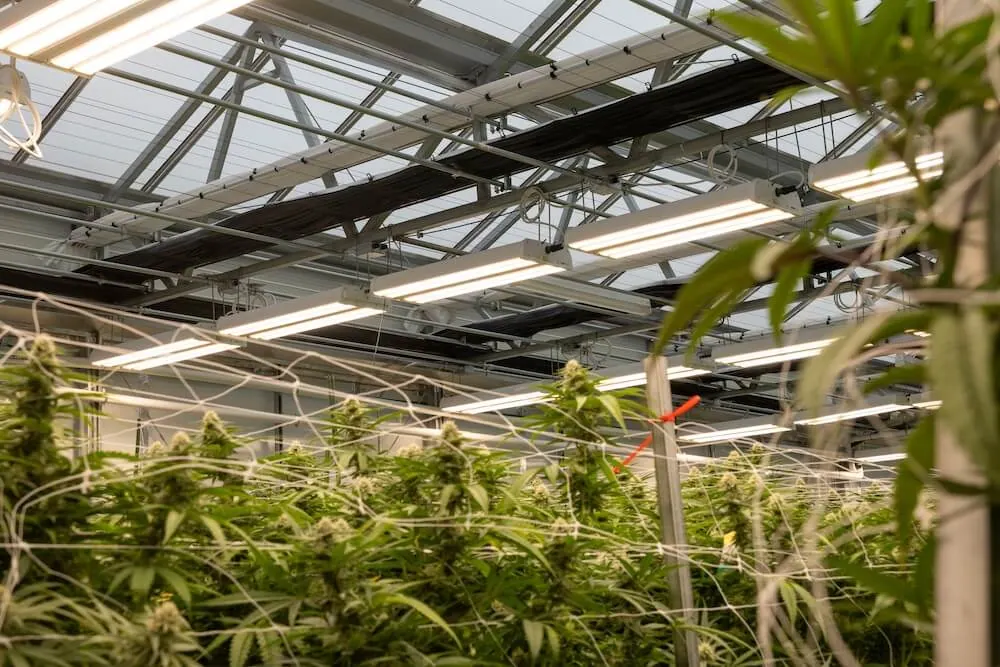
Obtuvimos estas conclusiones de alto nivel a partir de dos estudios. El primero fue un estudio de 2 factores en el que se investigó la interacción de la calidad de la luz (espectros R4, R6, R8 y R4+FR de Fluence) y la intensidad (1100 µmol-m-2-s-1 y 1500 µmol-m-2-s-1). En este ensayo se cultivaron tres variedades (un tipo 1, un tipo 2 y un tipo 3) y observamos una tendencia muy clara de que el rendimiento era directamente proporcional a la PPFD en este rango.
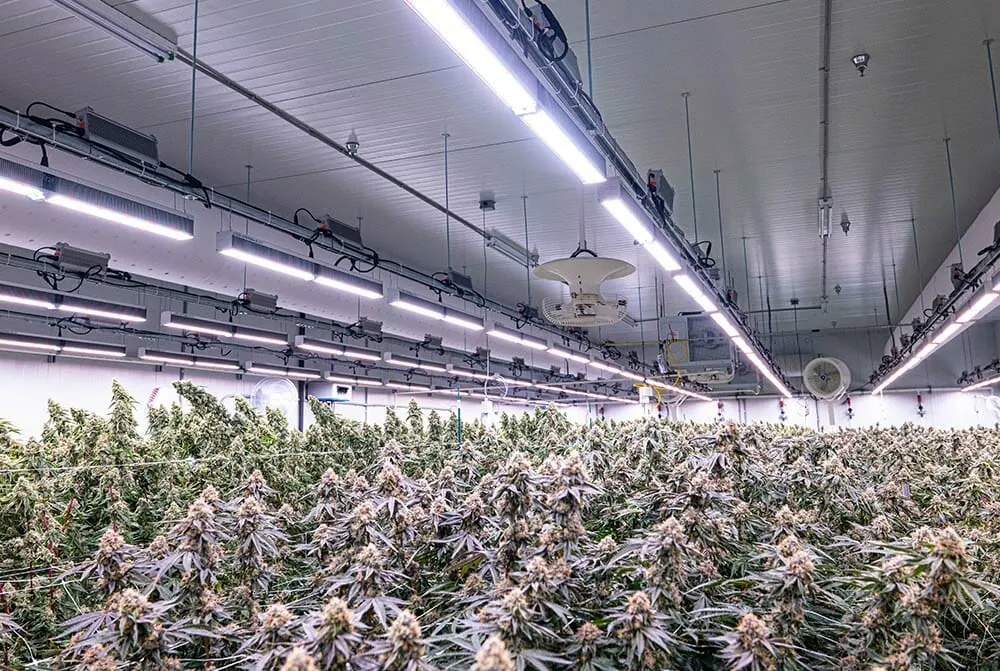
In the second study, we used only the R4 spectrum, and ran several light intensities maxing out at 2500 µmol·m-2·s-1. We expected that the 2500 µmol·m-2·s-1 treatment would fry the plants, and we only went that high for the sake of having the data point and seeing at what PPFD plants start to die. What happened was that, of the three cultivars we were testing, one of them (the type 2) continued its linear yield response up to 2500 µmol·m-2·s-1, and the other two cultivars plateaued around 2100 µmol·m-2·s-1!Also an interesting note, in this second study, the plants down at 1500 µmol·m-2·s-1 under-performed compared to what we had seen in the first study. This was initially puzzling, but made sense once we looked at the environmental data from the room. We implemented all of our light intensity treatments in one production environment to optimize the experimental design, but in doing so, we weren’t able to manage the massive humidity load we put on the room by driving plant transpiration with super high light intensities.
All this to say, although we saw two of our three cultivars plateau in yield response around 2100 µmol·m-2·s-1, it might be possible to push plant yield even higher with PPFD if you can keep the rest of the environment in balance! This is kind of crazy; no other horticultural plant comes anywhere near this. Moreover, these PPFD’s are so high already, that although we theoretically could upgrade our environmental infrastructure to manage greater humidity loads and run another experiment, the practical reality of doing so is unrealistic for us as a research group, and even further out of the question for a commercial production facility.
Conclusión
Así que ya está. Espero que esto haya sido informativo e interesante para cualquiera que no haya escuchado esta historia de nosotros, o para cualquiera que quiera escucharla de nuevo. Como siempre, las preguntas y los debates son más que bienvenidos, no sólo sobre este tema, sino también si tienes otras preguntas sobre la iluminación del cannabis.
DR. DAVID HAWLEY
Científico jefe
El Dr. David Hawley dirige la iniciativa de investigación científica en Fluence como científico principal de la empresa. Su experiencia en sistemas de ambiente controlado, iluminación hortícola y metaboloma del cannabis respalda naturalmente la misión de Fluence de impulsar la investigación en iluminación líder del sector para explorar la interacción entre la luz y la vida.