In a compelling presentation at MJBizCon 2024, Fluence Data Scientist Dr. Jason Matlock addressed one of the cannabis industry’s most pressing challenges: how to effectively use data to improve cultivation operations without becoming overwhelmed by complexity. As the cannabis industry continues to commodify and profit margins tighten, the ability to make data-driven decisions has become increasingly crucial for success.
“The key here is to recognize that collecting data is not the same as gaining insight,” Matlock emphasizes. “There’s a lot of companies who are collecting data, and they’re drowning in it. They have all sorts of records, but they’re not learning anything from that material.”
Comprendre la science des données dans la culture du cannabis
M. Matlock remet en cause l'idée reçue selon laquelle la science des données nécessite des systèmes d'intelligence artificielle complexes ou des réseaux neuronaux. Il présente au contraire la science des données comme un processus accessible qui commence par poser les bonnes questions. Des outils de visualisation simples, tels que les diagrammes en boîte et les graphiques linéaires, peuvent souvent fournir des informations puissantes lorsqu'ils sont utilisés de manière stratégique.
Types d'analyse des données
La présentation décrit deux types fondamentaux d'analyse de données dans le domaine de la culture :
- Enquête : Elle porte sur des événements ou des résultats spécifiques et cherche à comprendre pourquoi quelque chose s'est produit afin de reproduire les succès ou d'éviter les échecs.
- Suivi des processus : Il s'agit d'assurer l'exécution cohérente des meilleures pratiques connues.
Études de cas sur l'analyse des données relatives au cannabis
To demonstrate how data science principles can be effectively applied in cannabis cultivation, Dr. Matlock presented two compelling case studies. These examples showcase both investigative analysis and process monitoring in real-world scenarios, illustrating how systematic data collection and analysis can solve complex cultivation challenges. The first case study examines a temperature management issue that challenges common assumptions, while the second explores innovative approaches to standardizing defoliation practices. Both cases highlight the practical value of data-driven decision-making in modern cannabis cultivation.
Étude de cas 1 : Enquête sur la gestion de la chaleur
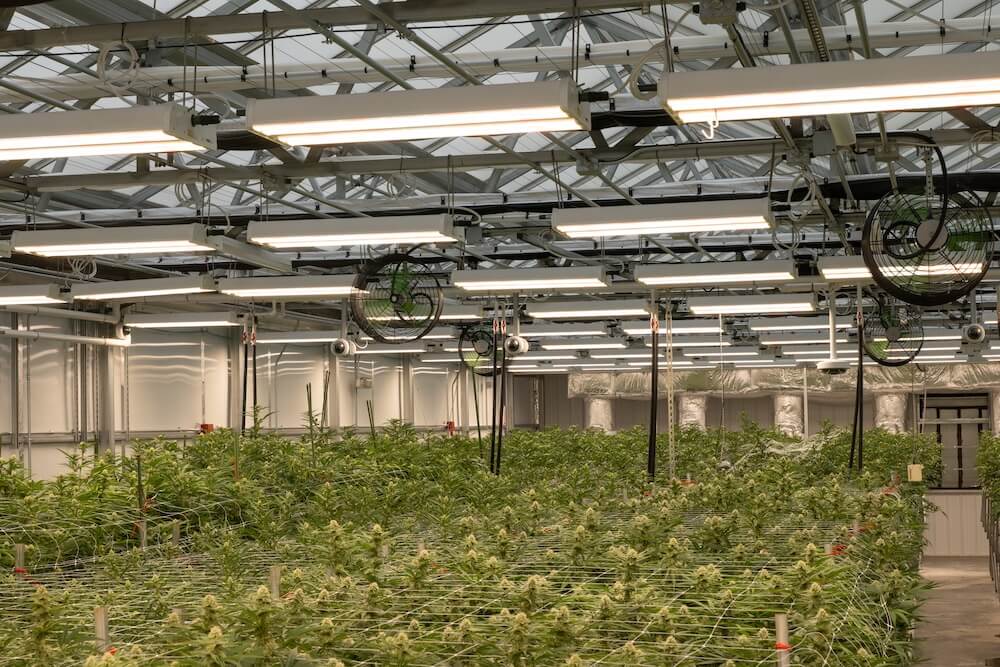
To illustrate these concepts, Matlock shared a practical example involving a client’s claim about Fluence fixtures causing excessive heat in their greenhouse. Through systematic data analysis using simple box plots, the team discovered that room location and insulation, not the fixtures, were responsible for temperature differences. This case study demonstrated how asking the right questions and following a methodical approach can reveal unexpected insights and solutions.
Étude de cas n° 2 : surveillance du processus de défoliation
The second example focused on process monitoring in defoliation practices, a critical but labor-intensive cultivation task. “How do we know if defoliation is standardized and under control?” Matlock asks. “If it’s that critical and we’re investing that much into it, why don’t we know objectively if we are successfully standardizing this practice?”
He presented two potential measurement approaches:
- Contrôle de la pénétration de la lumière dans la partie inférieure de la canopée
- Utilisation de l'imagerie automatisée pour compter les bourgeons visibles
Le choix entre ces méthodes dépend de l'échelle de l'opération et des ressources, illustrant la façon dont les solutions de science des données peuvent être adaptées à différents environnements de culture.
Processus de mise en œuvre
La présentation a mis en évidence un processus clair de mise en œuvre de la science des données dans le domaine de la culture :
- Commencer par des questions spécifiques et critiques pour l'entreprise
- Appliquer la compréhension du système pour identifier les mesures pertinentes
- Développer des méthodes de collecte de données appropriées
- Traiter les données pour mettre en évidence des schémas significatifs
- Analyser les résultats et prendre des mesures
- Répéter le cycle pour mesurer l'impact
Conclusion
“Data science at its core is meant to be accessible and empowering,” Matlock concludes. “Start simple, ask intentional questions, take steps to measure and refine what matters the most, and you’ll be successful. You can always build from there, but if you don’t start at that point, you almost certainly will become lost.”
The presentation effectively demonstrated that data science in cannabis cultivation doesn’t require advanced degrees or complex systems. Instead, it demands a methodical approach to asking and answering questions that directly impact business success. By following this systematic process and starting with simple, focused metrics, cultivators of any size can begin leveraging data to improve their operations and bottom line.
This practical approach to data science offers cannabis cultivators a clear path forward in an increasingly competitive market, where efficiency and consistency are paramount to success. The emphasis on accessibility and intentionality provides a refreshing counterpoint to the often-overwhelming world of big data and artificial intelligence, making data-driven decision-making achievable for operations of all sizes.
A propos de l'auteur
Dr. Jason Matlock brings over 10 years of experience in the cannabis industry, including commercial scale cultivation, facility design and construction, and business development consultation. He excels at integrating and balancing economic, logistical, and horticultural considerations when addressing operational challenges. Dr. Matlock has a proven record of success with designing and conducting grower-participatory on-farm research trials, and is skilled at performing statistical analyses on biological datasets and presenting results in easily interpretable formats.